
ADAPTATIONS: THE GOSPEL ACCORDING TO ST. MATTHEW
On Pier Paolo Pasolini's Defamiliarizing (or Very Literal) 1964 Adaptation of The Gospel Narrative


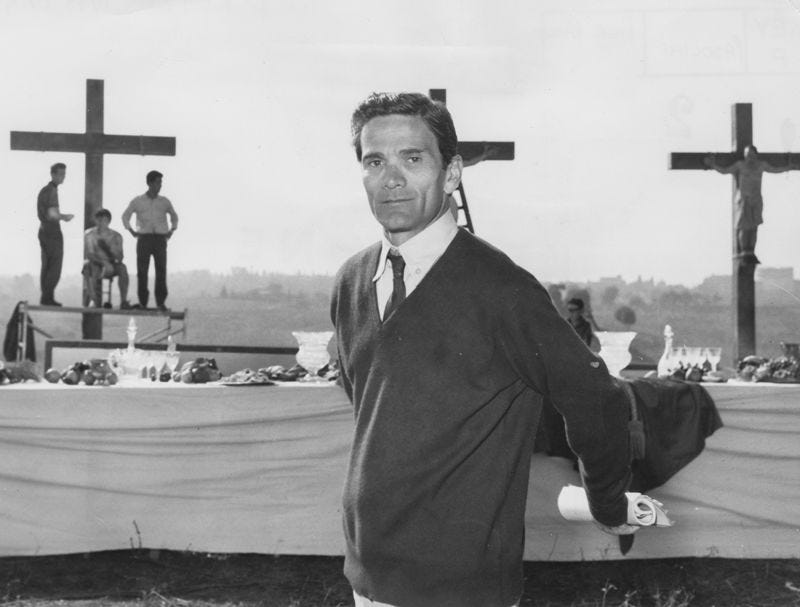
There is a teacherly tendency among film adaptations of the Gospels, in their conscientious efforts to sugar the bitter pill of Scripture and make the ancient stories more accessible and engaging. Dispensing with the spareness of the Biblical text, filmmakers recast the life of Jesus into a more expansive and emotionally involving realist form. And the severity of Christian judgment is softened with a kindly, relatable Christ, whose benevolence and all-too-human frailties are foregrounded. Jesus of Nazareth, for instance, portrays, in the words of its director Franco Zeffirelli, “an ordinary man—gentle, fragile, simple,” whose power consists in a humble moral gravitas, an unblinking blue-eyed gaze which can awe an angry mob into dropping its condemnatory stones. Scorsese’s The Last Temptation of Christ casts Jesus as a struggling human beset by fear, depression, and lust, and dramatizes spiritual themes with a self-questioning Christ engaged in profuse philosophical dialogue with other characters. Mel Gibson’s The Passion of the Christ makes explicit the brutal suffering Jesus underwent in carrying out his sacrificial mission, dying for all mankind because he loved us so much. What is striking about Pasolini’s The Gospel According to St. Matthew is its complete lack of interest in this conventional mission of humanization and relatability: his Jesus is strange, angry, and otherworldly, and his film bereft of dramatic elements of identification, conflict, and suspense which typically engage viewers. But somehow, by insisting on the remoteness of the story and the foreignness of the figure, Pasolini’s film conveys a more powerful experience of “faith” than its peers.
Pasolini treats the modern reader’s central difficulty with Matthew—its spare, austere narration, laden with knotty parables—not as a problem to overcome, but as a point of departure for telling the story. His film adheres quite strictly to the Gospel text, which furnishes its every scene and word of dialogue. And it adopts Matthew’s stark “exterior” narrative perspective, depicting events simply and matter-of-factly, without novelistic entry into the minds of its characters. Such storytelling is disorienting, offering randomness and emotional flatness where viewers might expect to find dramatic tension and psychological understanding. Jesus’s temptation by the devil, for instance, lacks emotional intensity and a sense of jeopardy: an unthreatening Satan offers his enticements blankly, and Jesus rejects them without any struggle. Christ’s calling of his first disciples—“Follow me, and I will make you fishers of men”—is tossed off casually, perfunctorily, without attempt to persuade, and the silent acquiescence of Peter, Andrew, James, and John offers explanation neither for why Jesus chose them nor for why they would uproot their lives to follow him. The conflict between Jesus and the Pharisees is minimally dramatized, the decision of the latter to condemn Christ to death a prosaic affair, a grim necessity of state rather than a personalized act of vengeance. Pasolini renounces dramatic involvement and psychological explanation not simply to convey an austere mood, but to create a distancing effect, in which the events onscreen are encountered as something strange, incomprehensible, not quite of this world.
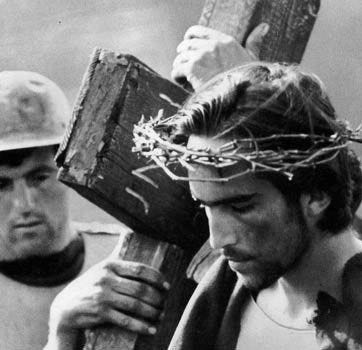
This estrangement is effected through the film’s portrayal of Jesus, which makes him an inward, inscrutable, and otherworldly figure. Played by 19-year-old economics student Enrique Irazoqui (a communist activist introduced to Pasolini by Elsa Morante), Pasolini’s Jesus lacks the “manly” physical presence found in many depictions of Christ. He is not the muscular Jesus of Mantegna and Michelangelo but a lean, slight figure, an airy, bird-boned ascetic. He is young and fresh-faced, with narrow, compressed features, lacking the bearded sagacity that comes with age, and keeping a shrouded head rather than flowing long hair. He has nothing of the benevolent redeemer: no kindly smile (except occasionally around children), no merciful outstretched arms, no personal warmth suggesting his love for humanity and willingness to suffer for its sins. He is instead an angry messenger, come down to warn and condemn, demanding repentance now that the kingdom of heaven is at hand, and excoriating scribes and Pharisees for prioritizing worldly position and the letter of the law. He issues his judgments and proclamations dispassionately, commanding rather than persuading, keeping his distance from his audience rather than working to bridge the gap. But however little there is in Pasolini’s Jesus to connect with, there is indisputably something about him: in his total self-assurance, his unwavering tone of voice, and his complete conviction in what he is saying. It is not Christ’s relatable human side that Pasolini emphasizes but his foreignness and incomprehensibility, his novelty and strangeness, his alien nature as an entity closer to God.
Rather than flesh out the story and “humanize” the character of Jesus, Pasolini uses image and sound to evoke the ancient world and enchanted consciousness in which his words and deeds were experienced. The dominant visual motif in the film is the human face, wearing a single fixed expression, shot in close-up. In early scenes, these painterly portraits evoke Christian iconographic tradition: much of the beginning of Matthew is rendered in art-historical depictions of the Virgin Mary, Madonna and Child, Holy Family, and Adoration of the Magi. The angel is boyish and Botticelli-curled. But when the adult Jesus begins to preach, the camera becomes taken with the faces of the peasants who encounter him. They are salt-of-the-earth faces: archaic, rough-hewn, sunburnt—embodiments of a hand-to-mouth existence, in direct contact with the elements. They take on the craggy, weather-beaten features of the film’s southern Italian landscapes, particularly of the old city of Matera, which grew out of a complex of cave dwellings carved into rugged limestone cliffs. But they are not wholly naturalistic figures, because the camera’s iconographic frame persists, and reveals their spiritual virtues. It captures in their simple immediacy their responses to this miracle-working preacher: awe, puzzlement, serenity, joy. It exalts their earthiness, not simply as a marker of the humble poverty that entitles them to the kingdom of heaven, but as producing a sense of the world as enchanted, a site of miracles, through which they can register that something extraordinary has occurred with Christ’s appearance, even if the content of his discourses has only begun to be assimilated. With its focus on receptive faces, Pasolini’s film works to evoke the naive wonder and trustful simplicity from which faith is born.
In contrast to the naturalistic images, the rough faces and the rocky landscapes, the film’s sound is light and ethereal, descending gently from an elevated plane. As is typical of a Pasolini film, the score features a lot of Bach, and other music marked in its own way by a sense of classical perfection. And just as several images recall devotional scenes from art history, several pieces in the score come from devotional music like Bach’s Mass in B Minor. The music is beautiful in its own right, but within the context of the film its power consists in its contrasts with narrative and visual elements. Pleading, lyrical arias like “Erbarme dich” from Bach’s St. Matthew Passion and Odetta’s negro spiritual “Sometimes I Feel Like a Motherless Child” provide an affecting counterpoint to the Bressonian restraint of the actors, and to the flat unrhetorical anger of Jesus’s voice. The heavenly, angelic voices of the choral pieces, including “Wir setzen uns mit Tränen nieder” from the St. Matthew Passion and “Gloria” from Missa Luba, a Congolese collection of songs for Latin mass, contrast strikingly with the film’s rustic and terrestrial imagery.
The dialogue too has a similar effect: dubbed in postproduction, the artifice apparent in the instances in which sound doesn’t track lips, the voices are airy and disembodied, separate from the likenesses onscreen, in a diaphanousness opposed to the coarseness of the images. The effect of these sharp juxtapositions of aesthetic opposites is a sort of enchantment, one which transports the viewer into a different consciousness—that of Pasolini’s own archaic agrarian world. His film is less interested in the person and message of Christ than in evoking the encounter with a Jesus who is manifest but not of the world, a human who belongs to the divine—in miracles, and the possibility of faith.
In Pasolini’s film, Jesus belongs to the people—not through his empathy or love, but as a product of peasant agrarian aesthetic experience, in which the world is understood through stories. In sticking to the original Matthew text, with its strange rhythms and tangled parables, the film conveys the quality of the Gospels as written-down stories, which survived the decades between Christ’s life and their bibliographic recording by passing on from mouth to mouth. And by including a number of distant, off-center shots of the preaching Jesus and the trial of Jesus, the film suggests the concrete and partial experience of the ordinary onlookers, who are witnessing something momentous that they will share with others, but which they can’t totally hear and understand. As Walter Benjamin writes in “The Storyteller,” the salient feature of the story, particularly in contrast to the novel, is its reliance not on understanding but on memory: on the listener’s integration of the story into his own experience, and on the teller’s transmission of his own experience in the telling. This is a product in part of narrative form: “There is nothing,” Benjamin writes, “that commends a story to memory more effectively than that chaste compactness which precludes psychological analysis.” But it is also a matter of the conditions of listening and experiencing. Benjamin suggests the importance of a “state of relaxation”: “The more self-forgetful the listener is, the more deeply what he listens to is impressed upon his memory.”
While Benjamin has in mind the self-forgetfulness that comes with work, with the ancient and medieval rhythms of weaving and spinning that precede modernity and “information,” art can also induce this condition, and this is the end of Pasolini’s enchantment. It evokes what was in fact the dominant experience of the Gospels for most of the history of Christianity, when masses were recited in Latin and people couldn’t read: looking at stained glass windows and church frescoes, listening to chants and liturgical music, reciting memorized prayers and hymns. It allows us to share with the listening peasants a kind of naive openness, a capacity to receive and remember, a state of relaxation which assimilates experience more deeply precisely because it doesn’t attempt to understand or explain. And this, for Pasolini, is the significance of the story of Christ in the modern era: not that of the benevolent redeemer, whose moral lessons we need to internalize and carry into our lives, but that of the simple encounter with an enchanted, miracle-laden, faith-inducing world.
 |
|
Agamben plays Philip in this!
pasolini’s best, & the only biblical movie i can stand to watch