
Diotima's Wild Children
Romantic Platonism and the Erotic Frenzy of Poetry


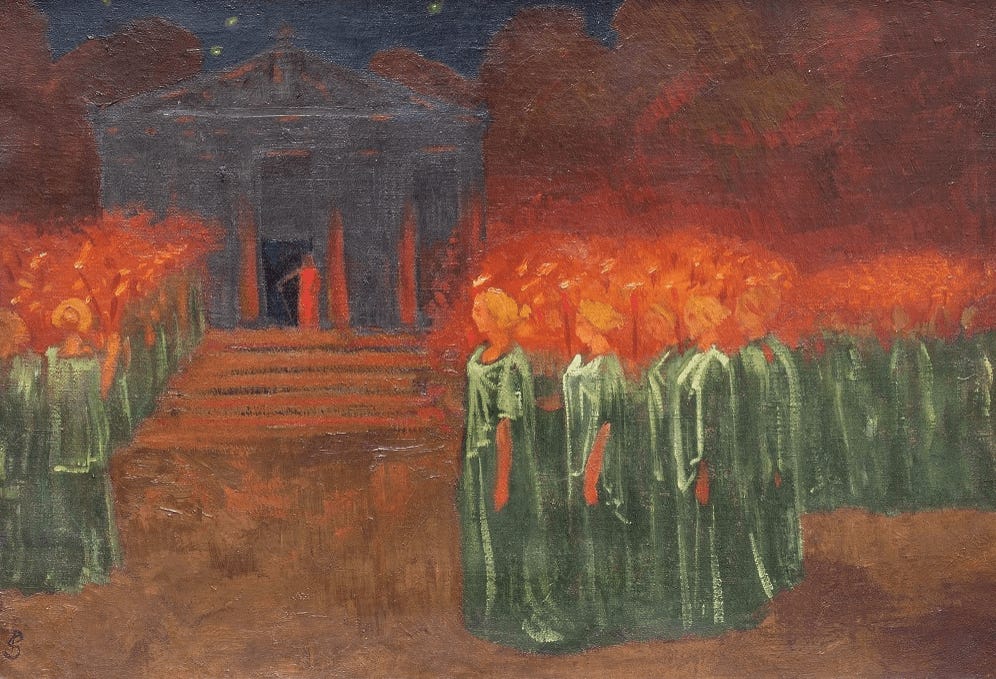
‘Holy Socrates, why always with deference
Do you treat this young man? Don’t you know greater things?
Why so lovingly, raptly,
As on gods, do you gaze on him?
Who the deepest has thought loves what is most alive,
Wide experience may well turn to what’s best in youth,
And the wise in the end will
Often bow to the beautiful.
—Hölderlin, “Socrates and Alcibiades”
Whenever a literary critic or intellectual historian wishes to contrast a social or artistic movement with any school of Rationalism, the word Romanticism is trotted out. This holds true whether an author finds emotion, mysticism, nature, and excess more desirable than prudence, clarity, culture, and moderation or vice versa. These are the assumed divisions; these are the binaries taken for granted. The frame of a struggle between head and heart, impulse and calculation, offers much material for reflection, but it has nothing to do with Romanticism as nineteenth-century cultural and intellectual movement in Germany and England. And if we let these cardboard cut-outs—of nature against reason and passion against philosophy—define the contemporary resurgence of interest in Romanticism, it will only end in catastrophe. As a person who thinks the philosophical and artistic approaches offered by Romanticism are in fact true and constitute badly needed resources which can propel us out of the dead ends of our time, this is not merely an academic exercise—the stakes are philosophical, in the broadest sense, political, even existential. These poet-philosophers possessed staggering intellectual gifts and vital spiritual power. We need them now.
The fact that the Romantics were philosophers who engaged in the most sophisticated metaphysical debates of their age eludes the perception of far too many critics and historians. The truth is that there is no “Romanticism” apart from the philosophical project of the Enlightenment, especially as that version of Enlightenment exemplified by German Idealism. We should speak instead of Romantic Idealism with many internecine struggles over how to relate ontology, art, history, politics, and even the Godhead.
The Cold War cultural consensus, however, visible in the works of Irving Babbitt and Isaiah Berlin, treats Romanticism as expressivism or merely aesthetic symbolism–in the rare moments it attains the status of philosophy at all. Romanticism is a mood, a gesture, a certain kind of style, all of which ends in a decidedly negative evaluation. For Babbitt, the antidote to Romanticism is a more hard-nosed literary humanism a la Matthew Arnold, a flavorless but hearty pudding of morality sans metaphysics. For Berlin, on the other hand, Romanticism threatens the low and solid bases of democratic liberalism: a liberalism defined for Berlin by anti-utopianism.
On the other end of the literary-theoretical spectrum, many postmodern admirers accept the caricature of Romanticism in order to mine it for post-metaphysical resources. We can observe this stance toward Romanticism in a long line of French and German thinkers, from Martin Heidegger to Jean-Luc Nancy (even the great Manfred Frank), as the mysterious sigil and chthonic passageway out of the gloomy prison of Western reason, making it possible to finally cast off the shackles of conceptual and critical reflection. Friedrich Hölderlin, in his body of oracular hymns and lyric poems and in his own bodily descent into clinical madness, is the ultimate symbol for those keen on this path into primordial Seyn. And while the postmodern renderings of Romanticism are far more serious and fruitful than those posited by the likes of Babbitt and Berlin, they remain one-sided and incomplete. As Frederick Beiser argues, these postmodern readings suffer from an insensitivity to “the Platonic concept of reason in Frühromantik; it neglects the close connection between romantic aesthetics and Naturphilosophie… [and] it injects an unnecessary element of obscurantism into Frühromantik, which makes it vulnerable to all the old charges of antirationalism.”
Scholars who take Goethe and Schiller as relevant precedents for Romanticism, but not Hamann, Lessing, Spinoza, and Kant, are incapable of understanding the Romantics on their own terms.What is missing from the twentieth-century reception of the Romantics—whose exemplars too often misread Romanticism in terms of a crude conflict between reason and feeling—is any engagement with the problems that animated the Romantics themselves: their metaphysical ambitions to unite the Real and Ideal, Subject and Object.
The Romantic Idealists wrestled with Spinoza, Kant, Jacobi, Fichte, Niethammer, and Reinhold, sometimes as students in their very presence. The assumption that the literary and philosophical can be neatly divided, let alone institutionalized, into separate departments that study two different subjects called literature and philosophy betrays a fundamental misunderstanding of the Romantic project.
The Romantics did make a decisive turn toward eros, frenzy, temporality, the flesh, affect, and the particular. But all of this was in the name of a higher understanding of reason, not irrationality, and a higher understanding of systematicity, not incoherence. In the terms of intellectual historian Dan Edelstein, if the Romantics rejected Enlightenment, it was only the name of a Super-Enlightenment. And, as Frederick Beiser has ably shown, the venerable received wisdom of an “antithesis between Frühromantik and Aufklärung has begun to crumble in the face of more detailed historical research.” These oppositions are neither desirable nor capable of being credibly defended as representing Romanticism.
In a letter to his friend Karl Gok (1798), Hölderlin profusely praises the arch-Enlightener, the sage of Königsberg: “Kant is the Moses of our nation, leading it out of its Egyptian lethargy into the open, lonely wilderness of his speculation and bringing the energetic law down from the holy mountain.” Rarely are the close friendships and connections between the Romantics and the Idealists, particularly Hegel, Schelling, and Hölderlin, allowed to tear down the wall of division between these supposedly opposite tendencies. Yet, the Tübinger Stift made Hegel, Schelling, and Hölderlin literally roommates and it was together that they gave birth to The Oldest Programme for a System of German Idealism (1797). It contains in miniature every battlefield of German metaphysics and philosophy of science and consciousness for the coming decades, and, in its cunning turn toward art and positivity, a few battlefields that rage among the combatants even now.
When the Romantic Idealists struggled in relating the new claims of critical reason and social emancipation with the desire for organic unity and revelation, they turned to a surprising source. What does the System-Fragment call that sense which unites absolute freedom, physics, political philosophy, the progress of humanity, and the Godhead?
Finally the idea that unites them all, [is] the idea of beauty, taking the word in a higher, Platonic sense. I am now convinced that the highest act of reason, that in which reason contains all ideas, is an aesthetic act, and that truth and goodness are only united in beauty… By this means, Poesy regains a higher dignity, and in the end becomes again what it was in the beginning: the educator of humanity; for there will be no more philosophy, no history. Poesy alone will survive all other arts and sciences.
It is Beauty and Poesy which overcomes the antinomies, Beauty in a Platonic sense. Plato, the hoary metaphysician himself, and the Platonism that Babbitt and Heidegger both agreed had nothing to do with Romanticism, turns out to be one of the most important fountainheads for Romantic Idealist philosophy
To those for whom “Platonism” signifies only disembodied abstraction and contempt for art and poetry, it may come as a surprise that almost every single Romantic (English as well as German) was enthralled with the Platonic dialogues and considered the systematic metaphysical exegesis of these dialogues at the hands of later Platonists to be an irreplaceable help for their own living thought.
The writings of Plotinus, Iamblichus, Damascius, Olympiodorus, and Proclus served as part of the justification for their own poetic practice and ontology of ecstasy. Like the Antique pagan and the Renaissance Christian Neoplatonists, Coleridge, Schlegel, Novalis, Schelling, and Hölderlin saw the Phaedrus and the Symposium as revealing the heart of Art, Beauty, Love, Reason, and the riddle of all metaphysical and dialectical enquiry. Nor did they require any appeal to secret doctrines or esoteric readings to do this. The images, narratives, and arguments of the dialogues contained everything they needed for this reading.
The pastoral and lyric character of the Phaedrus made perfect sense to the Romantics. It was incomprehensible to them that any reader could conclude that the visible and poetic beauty on display by the banks of the river Illisos, the river of purification for the Lesser Mysteries of Eleusis, meant nothing at all—as Babbitt would later claim. And for someone like Hölderlin, in whom the classically pagan and Christian medieval worlds hung together in an impossible simultaneity, it would have made perfect sense that the Illisos is the same river where later Greek Christians built a shrine to St. Photeine, the Samaritan woman to whom Jesus spoke at the well and promised the waters of everlasting life. Socrates speaks and prays with Phaedrus, not as a journey into the underworld, but as one who is describing and perhaps in some way experiencing epopteia—the language of the chariot-vision is drenched with Eleusinian and Orphic terminology.
In brief, the Phaedrus revolves around the question of rhetoric and desire. The young Phaedrus comes to Socrates, concealing within his robes a prepared speech on Eros by the sophist Lysias. Phaedrus explains that Lysias has argued brilliantly that relationships are better served by separating emotional passion from physical gratification. Socrates plays along, offering his own rhetorical condemnation of Eros—although he veils his face while he speaks. Paradoxically, the exchange between Phaedrus and Socrates itself contains an erotic charge. They become increasingly isolated, wandering outside the city walls along the blooming paths and rural shrines. As he starts to cross the Illisos and return home, Socrates cries out. Like Stesichorus, struck blind for blaspheming Helen of Troy, Socrates says he fears divine judgement: the judgement of Eros the god. And like Stesichorus’ palinode to Helen, a poem-song of repentance which brought back his sight, Socrates meticulously, dialectically, poetically, and metaphysically praises the divine madnesses, Eros included, which make us like the gods.
The Romantics, unlike many Plato scholars, took Plato’s account of madness seriously. The four maniai outlined in the Phaedrus: Apollonian-prophetic, Dionysian-telestic, Musaical-poetic, and Aphroditean-erotic present the ultimate metaphysical justification for art. It is divine. Mania is presented as explicitly superior to sophrosune as a form of transactional self-control. The practice of philosophy in the Phaedrus is led by the Muses, specifically the Muses of astronomy and epic poetry: Ourania and Calliope. It is the proleptic tasting of beatitude in the hints of hypostatic and godlike nature emerging, root and branch, stream and sward.
The ambiguous status of myth in Romantic Idealism also draws from Plato. It is the natural world, infused with myth, which provides Socrates, in the Phaedrus, with a crucial image and direction for their task. The famous cicadas, actual living singing insects, constitute the perfect emblem for the Platonic use of the Muses and of the erotic lyric poetry of Sappho. It is Socrates, not Phaedrus, who points out the beauty of the location and Socrates, not Phaedrus, who brings up the myth of the cicadas (traditional myths from which he allegedly learns nothing). Socrates urges Phaedrus to continue their philosophical discussion because the cicadas used to be men who loved the Muses and refused to stop their task even to eat or drink. They too must be transformed by the practice of philosophy under the auspices of the gods and Muses. Socrates forbids Phaedrus’ transactional account of rational self-interested love as blasphemy and calls for a recognition of the holy wisdom poured into their ears from ecstatic, erotic, dithyrambic lyricists like Anacreon, Sappho, and others. It is these, not the discursively clever Lysias that Socrates explicitly praises as the wise men and women of old (235b). The Romantics, and Hölderlin in particular, knew that poets, myth-makers, priests, and lovers are Heilige Gefäße filled with des Lebens Wein.
Many influential readers of Plato take the myths, or his use of lyric and mysteric language, as sops for the masses, the effeminate supports needed to prop up the souls who are incapable of manly dialectic. Even worse, the myths are sometimes read as helpful deceptions, making it easier to control the masses. Luckily, the Romantics did not read Plato with the perverse instincts of an unreconstructed Hobbesian. They read him as someone open to divinity through imagination and as someone who claimed that his philosophical quest was given him by the god of poetry and oracles, Apollo himself. It should be no surprise then, when we read in the System-Fragment that myths are helpful for the masses for the same reason that they are helpful for the philosopher; namely, the sensuous must be united with the conceptual. Imagination and intellect cannot be divorced. It is this conviction that produced the famous statement from three students in a Lutheran theological seminary: “Monotheism of the reason and the heart, polytheism of art and the imagination, that is what we need!”
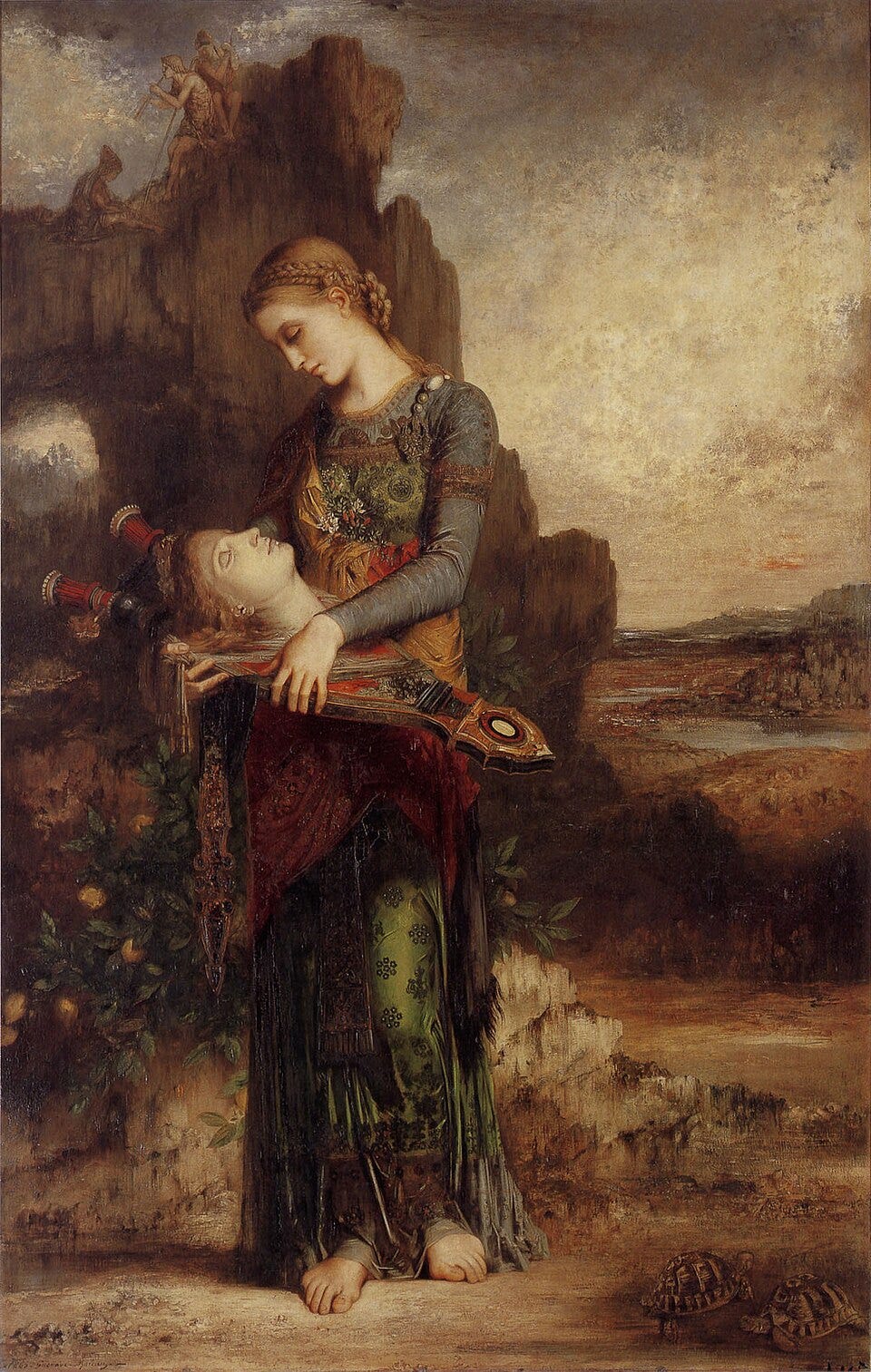
Of course, Plato gives more than one origin for Socrates’ philosophical quest: the more diurnal sunlit Apollonian origin as well as a nocturnal one with an even younger Socrates being instructed by the miracle-working priestess Diotima in the Symposium. And because the figure and function of Diotima looms so large in the Romantic consciousness, it is worth our time to remember her character and role in the dialogue with some concrete detail.
Socrates introduces his memory of Diotima by calling her, without much preamble, his instructress in the arts of love (ta erotika). She had traveled from Mantineia to Athens in order to delay the plague that would famously strike Periclean Athens. Astonishingly, Socrates mentions almost as a passing aside that she was successful in delaying that gruesome catastrophe by a decade! Whether this was through skill in offering sacrifices or by means of a direct thaumaturgic act is unclear. Either way, Diotima is immediately established as possessing almost incomprehensible power. How she became his teacher is never explained; however, there are hints that the young Socrates is being assessed or prepared for something to come. The reader immediately notices how the young Socrates is uncharacteristically depicted as flustered.
For readers of the Platonic dialogues, the shift from Socrates as a clinical dialectician who dismantles his interlocutors with little effort to a Socrates constantly on the back foot is jarring. At certain moments, he seems almost to plead with Diotima and reproach her for asking too much of him. “If I had known, I should not have wondered at your wisdom, neither should I have come to learn from you about this very matter” (206b). She is often smiling or laughing at the responses of Socrates. In at least one place Diotima actually shushes him: “Hush, she cried” (ouk euphemeseis or ‘will you not avoid words of ill omen?’) (201e). This is not to suggest that her tone is cruel. Diotima evinces genuine interest and even a gentle concern for her pupil at times. Yet, there is a constant and unmistakable undercurrent of authority in the content of her teaching and the manner of her presentation. The young Socrates is being subjected to a kind of purifying examination that is meant to cultivate a reverential attitude. One place that conveys this is when Diotima makes a half-joking comment, “These are the lesser mysteries of love (ta erotika) into which even you (kan su), Socrates, may enter (mutheies).” The banter at Socrates’ expense, however, quickly shifts to a more serious tone. Diotima is now clearly speaking of a kind of cultic initiation: “To the greater and more hidden ones (ta de telea kai epoptika) which are the crown of these, and to which, if you pursue them in a right spirit they will lead, I know not whether you will be able to attain. But I will do my utmost to inform you, and do follow if you can” (209e-210a). The good-natured ribbing that suggests Socrates can only enter the lesser mysteries is accompanied by the solemn promise that Diotima intends to prepare him for further sacred revelations to the best of her ability.
The terminology of initiation (mutheies) and mysteries (mustika) is that of the Eleusinian mystery-cult. Nancy Evans argues that “Plato’s fourth-century audience would have immediately made the connection between Diotima’s rites of love (erotika) and Demeter’s rites of initiation (mustika) when they heard Diotima mention her higher grades of initiation (epoptika) and their rituals of sight.” The word epoptika in particular has no known meaning outside its unique association with the Eleusinian mysteries. Even the language of “greater” and “lesser” mysteries has a known cultic equivalent. A candidate participating in the lesser mysteries, held in Athens by the banks of the Ilissos, would be made one of the mystai. The mystai at a later date would then walk eleven miles in a festive procession to the city of Eleusis where the greater mysteries, the culmination of the ritual, were manifested in the sacred Telesterion. Diotima’s tutelage of Socrates is a promise to lead him in a sacred procession to a culminating vision of divine union. “The encounter with Beauty and Being is depicted as a rite that one can be initiated into as one was initiated into the rites of Demeter at Eleusis.”
For Schegel and Hölderlin, Diotima was a perpetual reality, the initiator and high priestess of all true philosophers, theologians, and poets. Yet Diotima was also particular, embodied women, women they desired: Caroline Schelling for Schlegel and Susette Gontard for Hölderlin. And in this merging of metaphysics and bodily eros, all of history and politics came tumbling in as well. The genuine addition that Romanticism gives to Plato is the historical drama of Eros and Being, itself downstream from Lessing and the full entrance of Christian eschatology into metaphysics.
The politics of Romantic Idealism is famously inchoate, producing high Church conservatives like Wordsworth and Coleridge, supporters of Enlightenment monarchy like Schlegel, Schelling, and Hegel, and revolutionaries like Shelley, Byron, and Hölderlin. In 1805, Hölderlin, along with his friend Isaac von Sinclair, was arrested for his participation in a Jacobin plot against the Elector of Württemberg. The erotic metaphysical quest of art could not be separated from the historical-political quest for human emancipation. It is why Hölderlin’s longest work involving the image and name of Diotima, his epistolary novel-poem Hyperion, centers around the Greek war for independence. Yet even here, in the Romantic interest in the historical, practical, and productive, we can spy a debt to the Platonic Diotima. Her great speech, the ladder of Eros by which souls traverse from beautiful bodies to Beauty Itself contains at its penultimate rung the beauty of epic poetry (Homer) and the beauty of political constitutions.Diotima praises those who were pregnant and gave birth in their souls: Homer, Hesiod, Lycurgus, and Solon. The limitless sea of Beauty is not meant for passive contemplation. Beauty impregnates and the philosopher must give birth to truths and Truth. Or, as Hölderlin puts it, philosophy is preparatory to artistic production: philosophy is a hospital for sick poets.
The way in which the works of Plato, most definitively in his Phaedrus and Symposium, undergird the Romantic project can be seen in Hölderlin’s 1793 July letter to Christian Ludwig Neuffer. Here the debt to Plato is manifest in even the most interior and private correspondence and is worth relaying at length:
It is true I wrote to Staudlin: Neuffer’s quiet flame will be burning more and more brightly when my straw-fire will perhaps long have died out; but this thought doesn’t always put me off, least of all in the heavenly hours when I return from the quickening embraces of nature or from the grove of plane trees by the Ilissos where, lying among Plato’s disciples, I have watched the great man’s flights through the obscure distances of the beginning of the world or followed him into the vertiginous depths, into the remotest reaches of the country of the spirit, where the soul of the world sends out its life into the myriad pulses of nature to which the issuing forces, at the end of their immense cycle, return; or when intoxicated by the Socratic cup, and by Socratic friendship, I have sat at the banquet listening to the sweet and fiery talk of the enthused youths paying tribute to sacred love, with Aristophanes the joker throwing in his flashes of wit until at last the master, divine Socrates himself, with his heavenly wisdom, teaches them all what love is—then, my beloved friend, I admit I am not so despairing and sometimes I think I must be able to instil into my little work some spark of the sweet flame that warms and illuminates me at such moments, into my Hyperion, which at present is the life and soul of what I am, and also manage from time to time to produce something else for the delight of men and women.
Is there then, an impossible contradiction between this Romantic enthusiasm for the divine Plato and the assiduous Romantic engagement with critical Idealism? How could the Kant who condemns all metaphysics before his critiques as naive dogmatism (and Plato especially as an irrationalist mystic) be the “new Moses”? The adumbration of the distinctive features of Romantic metaphysics and their path through Kant’s Third Critique requires its own essay. For now, at the very least, if the contemporary advocates for a New Romanticism, among which I count myself, have any desire to learn from the achievements of historical Romanticism, we must rediscover the insights that made Schlegel say at the end of his life: “It is now thirty-nine years ago that I read through the complete works of Plato in Greek with indescribable curiosity; and since then…this philosophical enquiry [metaphysics] has always been my proper main concern.” The frenzy of the poet, the lover, the priestess, and the prophet are a divine metaphysics: the truest philosophy possible.
 | A guest post by
|
A very nice survey, thank you. It's no accident that Shelley translated the Symposium (an excellent version, unpublishable in full in 19th-century Britain, for obvious reasons), the Ion, and I think the Phaedrus (his version now lost, unfortunately).
"If the Romantics rejected Enlightenment, it was only the name of a Super-Enlightenment."
Wow. Thank you (and Dan Edelstein) for this.