
Icarus in Alaska
On Jack Gilbert, Rainer Maria Rilke, Martin Hägglund, Mark Johnston, and The Arctic, or Love, Death, and Afterlife.


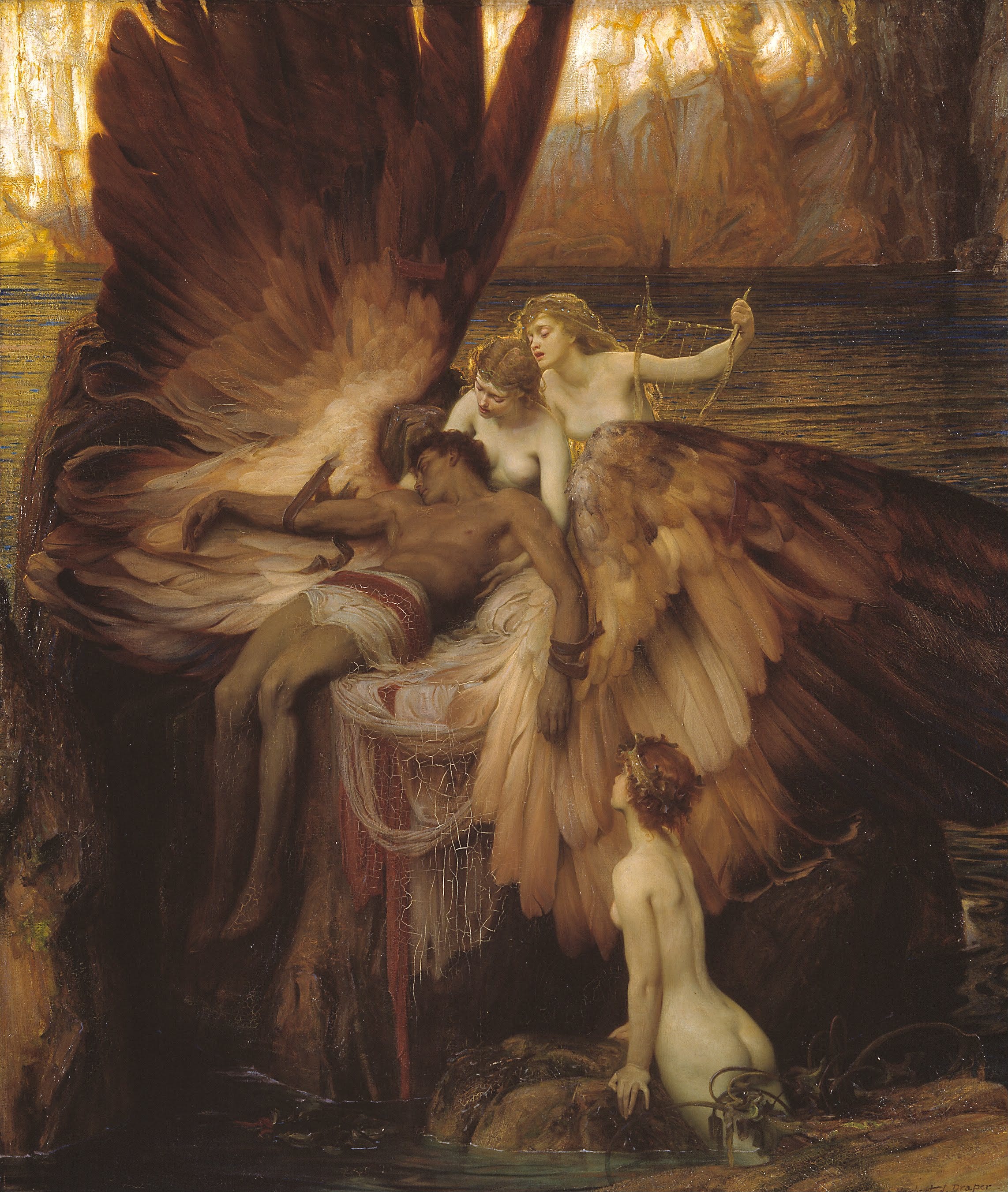
Everyone forgets that Icarus also flew.
It’s the same when love comes to an end,
or the marriage fails and people say
they knew it was a mistake, that everybody
said it would never work. That she was
old enough to know better. But anything
worth doing is worth doing badly.
Like being there by that summer ocean
on the other side of the island while
love was fading out of her, the stars
burning so extravagantly those nights that
anyone could tell you they would never last.
Every morning she was asleep in my bed
like a visitation, the gentleness in her
like antelope standing in the dawn mist.
Each afternoon I watched her coming back
through the hot stony field after swimming,
the sea light behind her and the huge sky
on the other side of that. Listened to her
while we ate lunch. How can they say
the marriage failed? Like the people who
came back from Provence (when it was Provence)
and said it was pretty but the food was greasy.
I believe Icarus was not failing as he fell,
but just coming to the end of his triumph.
(Jack Gilbert, “Failing and Flying”)
1.
Poet Jack Gilbert invokes the mythological figure of Icarus in “Failing and Flying,” his elegiac embrace of the loves we lose. Icarus is the son of Daedalus, the mythic inventor. The rebellious son dons his father’s wax wings, against paternal prohibition, and takes to the air only to fly too near the sun. The wings melt and Icarus falls to his death. If Prometheus, the titanic thief of fire, represents that pole of Ancient Greek myth under which we can trace a proto-modern celebration of human reason, or techné, arrayed against arbitrary limits, Icarus exemplifies the spirit of Greek tragedy in his foolishly hubristic drive to break from earth. (The figure of Daedalus, and his ignored warnings, here suggests it is not tools that are the problem so much as their improper use.)
But what does this have to do with erotic disappointment? Rather than an icon for technological striving and its perils, Gilbert repurposes the Icarus myth as a vehicle for the peculiar delight that inheres in romantic failure. Everyone forgets that Icarus flew for those few brief moments. Great love is not a goal-directed enterprise—success measured in the longevity of the relationship or some rationally planned telos, especially when our common fate is oblivion in the end.
Love instead resides in that moment when the lover spies his beloved “asleep in my bed/like a visitation, the gentleness in her/like antelope standing in the dawn mist.” Love is the epiphany that arrived as you watched her “coming back through the hot stony field after swimming,/the sea light behind her and the huge sky on the other side of that.”
Rather than striving to conquer the sky, this Icarus grasps at those lapidary instants when sky, sea, and beloved merge: a transient yet triumphal marriage which so thoroughly remakes you—after the end of the initial “win”—that you walk into the after days transformed into something else altogether.
The under-appreciated Gilbert sang of loss and longing in a voice spare and direct: his poetry offers us a minimalist neo-romanticism. This minimalism in turn masks the multiplicity of allusion in the poem; Gilbert explicitly uses the Icarus myth to tacitly conjure other mythological figures and tropes such as Epimetheus and Orpheus.
The Titan Epimetheus—whose name in Greek means “backward looking” or hindsight as opposed to his forward-looking brother Prometheus or “foresight”—is charged by the gods with distributing attributes and instincts to all mortal creatures. These distinguishing traits include the fish’s fins and gills, the snake’s scales and poison bite, the lion’s claws and teeth alongside the flower-pollinating, honey-making suite of powers that define bee-hood for the bees. Yet forgetful Epimetheus didn’t pack any gifts for human beings—his brother’s creation, at least in some versions of the myth. Epimetheus forgets, and our defenseless and constitutionally underdefined situation stems from his forgetfulness: a mythopoetic figure for a primal human condition that requires the various technological prostheses provided by Prometheus as a result, according to philosopher of technology Bernard Stiegler.
Renegade priest and neo-Luddite prophet Ivan Illich saw in this same myth of Epimetheus a countercultural alternative to the destructively counterproductive and ecologically Promethean program that united industrial capitalism and state socialism during the late Cold War. This vision of Epimetheus— centered on his later marriage to Pandora—conveys not foolishness but hope, since Illich follows the later Goethe, Robert Graves, and several contemporaneous eco-feminists in reading Pandora as an earth goddess distorted into the image of temptress, as Illich recounts:
The original Pandora, the All-Giver, was an Earth goddess in prehistoric matriarchal Greece. She let all ills escape from her amphora (pythos). But she closed the lid before Hope could escape. The history of modern man begins with the degradation of Pandora’s myth and comes to an end in the self-sealing casket.
For Illich, Epimetheus, in embracing Pandora, despite the ills she released into the world, embraces hope alongside the losses that so often attend love. Illich’s Epimetheus in this way converges with Gilbert’s Icarus: erotic martyrs both.
The Epimethean or retrospective mode is even better personified in Orpheus, the great singer whose song acquires another sort of gravity—and pathos—after he loses Eurydice, a second time, for looking backward as he leads her up from the Underworld.
But she survives in Orpheus’ song despite the loss, so “how can they say the marriage was a failure?” Even though love can and most probably will end, we should nonetheless commit to this love and its endings. As opposed to failure, love and loss of all sorts are transformative according to Gilbert’s neo-romantic ethos, which very much rhymes with Rilke’s Sonnets to Orpheus:
And these things,
that live only in passing, they understand
that you praise them. Fleeting, they look to us,
the most fleeting, for help. They hope that within
our invisible hearts we will change them entirely into—
oh endlessly—into us! Whoever we finally are.
(Rainer Maria Rilke, “Ninth Elegy”)
Although Rilke apparently rejected personal immortality, he still saw in death a peculiar sort of transcendence. It is by dying that we alienated human beings rejoin the ensemble of Being—creatures and things, nature and cosmos—returning home from our “interpreted world” to become “knowing [or unknowable?] animals,” trees, and stones. It is, conversely, through our poetic language—and the kind of self-awareness such language requires— that nature achieves completion. How we “change them entirely into—oh endlessly—into us!”
“Whoever we finally are”: immortality is real for Rilke by way of those lyrical commemorations that preserve the image and voice of the dead among the living. Why unrequited love—or the love of those who give themselves wholly to an other without expectation of recompense and in rehearsal of death’s becoming Other— plays such an outsized role for the Rilke of both the Duino Elegies and the Sonnets to Orpheus: “you almost envy/them this—forsaken, abandoned and unrequited, /who have so much loving in them/than those who are satisfied.”
These lines from the “Third Elegy” could very well serve as a statement of purpose for Rilke’s late twentieth century American disciple Gilbert, as he explores the ways “failed” love makes us what we are even as it prepares us for the death we can only survive through songs and the other selves that sing them.
I discovered Jack Gilbert’s work about two years ago by way of “Failing and Flying” as I was recovering, trying to recover, from a devastating breakup.
Gilbert’s work accompanied me through that catastrophe and a subsequent bout of love, turmoil, and ending—another ending—over the last year. And again: it will continue.
But, as Gilbert tells us in his own Orphic shorthand, such loss is no failure. And no love is ever lost: we absorb our loves and the grace they gave us: these are the gifts of profane transfiguration. We carry them with us, indelible marks or scars, yes, but also a chorus of voices we’ll take to the grave.
2.
When I was 24, a sudden and unexpected loss made me half-mad with grief before driving me north to an arctic corner of Alaska. My madness took the form of a fruitless search for consolation after the sudden and unexpected death of my ex-girlfriend S. at the age of 23. Things were unresolved with us, as I wrestled with my own guilt over past sins related to the relationship. While I lost my religion as a teenager, embracing a callow flavor of existential despair, I desperately sought evidence of life beyond life in the face of this great bereavement.
I was at least ecumenical in my seeking, at first immersing myself in UVA psychologist Ian Stevenson’s various studies of reincarnation—his research based on interviews with children the world over—before realizing that if what I sought was my lost girl, her reincarnated self, another self in every way, would not be her at all (i.e., how and why does reincarnation qualify as life beyond life, especially in Buddhist contexts that deny the reality of a substantial self—Anatman—which persists?).
I at one point revisited my childhood Catholicism, retiring to a Trappist monastery outside of South Carolina for a month: to dry out, wrestle with the God in whom I only sometimes believed, and cultivate silence. In fact, the point was to bury my despairing self in the liturgy of the hours and the manual labor on the chicken farm that supported the monastery. It only partly worked, as I too often fell back into the hole of grief I sought to escape; it wasn’t silence so much as the scarce conversation allowed us an hour each day that offered me some solace. I discovered many of the monks were veterans of various wars and had known loss of all kinds. It was also during one of these conversations that I learned about a Catholic radio station in Nome, Alaska. As my stint as the monastery was ending, I imagined Arctic cold and dark might best suit my psychic condition, aligning inner and outer landscapes.
Nome is an Alaskan gold rush settlement that sits across the narrow Bering Strait from Siberia, known as the Ice Curtain during the Cold War. The town resembles a trailer park, for structural or climatic reasons. You can’t build foundations into the permafrost, which, even then, was beginning to buckle as it thawed: a perilous frozen desert far above the tree line.
I secured a position at a Catholic radio station through the abbot’s efforts. Unlike the Trappists, the radio station was staffed by ideologically rigid laypeople who struck various colonial poses as they “ministered” to the sometimes-inaccessible Inuit communities scattered throughout the Seward peninsula where Nome is located. Although I was, at that point, humbled by grief, my contrarian streak endured—for instance, when I referred to God as a “She” during one broadcast. I subsequently managed to land a job at the local newspaper, bringing my short stint at the station, and concurrent flirtation with my childhood Catholicism, to a close.
It was in the long arctic dark that I finally dispensed with the fantasy of finding some surefire evidence of individual immortality, accepting both the fact of finitude and S’s passing—so long after I’d given up on Kübler-Ross’s five stage program—while coming to some inchoate understanding of life after death as the persistence of the dead within the living.
I had a quasi-occult revelation during a wild night that started early one dark day in late autumn. I was drowning in the midday murk by Halloween. The long darkness descends by noon so far north, after a brief sunrise oddly crepuscular in its half light. I was also drowning in alcoholic self-medication, which usually began with a White Russian alongside my morning coffee. My abortive plans for going dry aside, I was certainly not alone in this (mal) adaptive response to an inhumane climate. This is a town of a few thousand people that boasts something like eight churches and nine bars.
I was hunched over a beer in the town’s nicest bar: a well-lit hovel which the town’s then-mayor—also vice-president of the Alaska gold company—called his “office.” Mayor Goldmine half drunkenly ruptured a depressive reverie when he offered to buy me another drink I didn’t need before slurring through his family history. He was a descendant of the first settlers who came to the place during the Alaska Gold Rush—Norwegian fortune hunters who found what they were looking for, then established a roughhewn dynasty on the backs of the Inuit. The story of America in miniature, I thought, but not for so long that my mind didn’t drift back to my own mourning. I let him take me to the gold mining company headquarters in a large snowmobile.
“Do you want to see a really big fucking chunk of gold?” he muttered in his office before heaving a gaudy baseball-sized block of the stuff at me. He barely missed, as I briefly thought about grabbing the rock we deem wealth and running away into the frozen night: more suicide wish than heist fantasy at the time.
“Going outside for a minute,” I slurred.
It was several degrees below zero as I vomited onto the permafrost beneath the prismatic shimmer of the northern lights marbling the clear blue night sky, girdling what appeared, in my disordered state, a mocking circus of constellations.
“I am not among the starlight,” I heard her say in my mind’s ear. I repeated the sentiment, howling into the wind: “not among the stars.” My would-be friend drunk-drove me back to the room I was subletting off the main street.
S. was gone; S. persisted: one voice among the many that made me, and make me still, alongside the great and bloodletting memories—of the aurora borealis on the tundra—what I am: patchwork and chorus both.
3.
Martin Hägglund contends it is our shared finitude and fragility that allow us to pursue meaningful human projects and relationships, as he writes in This Life:
Happiness consists in having and holding what you love. But since you and the beloved are temporal, your having and holding will always tremble with the anticipation of mourning. The moments you stretch out to keep in memory may be taken away, and the possibilities you strain toward in hope may never arrive.
Hägglund makes the case for the necessary relationship between finitude and freedom in an individual life, making mincemeat of ideas such as individual immortality and Nirvana, or the cessation of all longing, which he describes as an “apparent paradox” because “to rest in peace is to be dead.” What Hägglund—offering an updated version of romantic existentialism with his model of “secular faith”—cannot countenance is the extent to which self-evacuation in the form of an “afterlife” is a hieroglyph for the desire to transcend our reified selves or egos. This is ironic considering that Hägglund’s analysis here also functions as philosophical foundation for his call to a new democratic socialism. Keeping this in mind, natural theologian Mark Johnston’s peculiar defense of life after individual demise is a useful supplement to Hägglund’s argument.
Selfhood is Protean for Johnston, and it is only through love of the other that each of us is able to transcend our narrowly egoistic selves, as he writes in his “A New Refutation of Death” (the last lecture in Surviving Death):
You love your neighbors, the arbitrary others, as yourself, and in that way you learn to love yourself with proper impersonality, namely, merely as another, one whose needs you learn of in a particularly immediate way.
Johnston proceeds from the same naturalistic premises as Hägglund. But, while the latter dismisses religious ideas—such as Nirvana and Anatman—as incoherent, the former sees in these beliefs myths and metaphors for the way we surmount an illusory version of selfhood. Selfhood— insofar as the self is taken as bounded, essential, and enduring over life and time—is nonsensical for Johnston. Johnston draws on religious traditions, such as Buddhism and Christianity, and a certain strand of Anglo-American analytic philosophy exemplified by the work of Derek Parfitt, in demolishing this shibboleth in favor of another model of consciousness, an alternative vision of life after death:
In identifying fundamentally with the interests of the arbitrary other you will have become something that is present whenever and wherever embodied human personality is present. You will live on, as Mill puts it in his remarks about the Religion of Humanity, ‘in the onward rush of Mankind.’ You will live on in the onward rush not metaphorically as Mill intended it, but literally.
In loving others as ourselves, we both internalize those others while expanding an already porous and fungible self—which Johnston reconceptualizes as a relatively durable “center of consciousness” and no more than that—to encompass other such selves: outward unto an approximation of a virtually immortal collective being. This is how time-bound and finite individual beings—whose finitude underwrites meaning and freedom, as per Hägglund—survive death even after we expire. Johnston in this case offers us a naturalistic redefinition of Agape—the self-evacuating and sacrificial love at the heart of the Christian story—while rejecting erotic love, during his discussion of Tristan and Isolde, as an equally valid template for worldly transcendence.
Yet romantic love, especially in its tragic or failed manifestations, is a school for learning how to die and surviving death. This love—contra Johnston—is usually how we first get past our selves in ecstatic union, and more. Eros shades into Agape. And it is through the loss of such love that we first die, and survive the death, as both Rilke and Gilbert recognized: carrying our lost beloveds with us, becoming other, multiple, beings in carrying them.
A darksome girl recently recounted to me her wrestlings with the specter of romances past but, apparitionally, present. “Were they wastes of living?” she asked.
No: the ghosts of love that has run its course inhabit us after the fall and in inhabiting make us other than what we would have been. But the transformations wrought by loss aren’t necessarily transfigurations—we too often emerge from loss deformed in ways large and small—or at least we are not transfigured instantaneously; suffering is the alchemical supplement in these cases.
For Johnston, if selfhood is a thing at all, it is malleable and non-individual: we stitch together one then another consciousness, ever shifting like some tapestry of fire, from everyone we’ve known and loved, fucked and hated, so that on the precipice of my ending, it isn’t some solid and stable Anthony about to perish but a chorus of lovers and friends singing out of tune. The song survives:
Ah, you three women whom I have loved in this
long life, along with the few others.
And the four I may have loved, or stopped short
of loving. I wander through these woods making songs of you. Some of regret, some
of longing, and a terrible one of death.
I carry the privacy of your bodies
and hearts in me. The shameful ardor
and the shameless intimacy, the secret kinds
of happiness and the walled-up childhoods.
I carol loudly of you among trees emptied
of winter and rejoice quietly in summer.
A score of women if you count love both large
and small, real ones that were brief
and those that lasted. Gentle love and some
almost like an animal with its prey.
What is left is what’s alive in me. The failing
of your beauty and its remaining.
You are like countries in which my love
took place. Like a bell in the trees
that makes your music in each wind that moves.
A music composed of what you have forgotten.
That will end with my ending.
(Jack Gilbert, “Cherishing What Isn’t”)
Updike: That a marriage ends is less than ideal; but all things end under heaven, and if temporality is held to be invalidating, then nothing real succeeds.
Love this meditation on how loss reshapes us rather than just diminishing us. The Alaska narrative really anchored the philosophical stuff, especialy the moment under the aurora where absence became presence in a different form. I went thru a similar reckoning after my dad passed and found myself arguing with Johnston's view that romantic love is somehow less transformative than agape. If anything, theloss of romantic connection taught me way more about self-evacuation than any abstract ethical principle ever could.