
John Clare at Midsummer
On Midsummer, Enclosure, and John Clare's Vision of The Ritual Year.


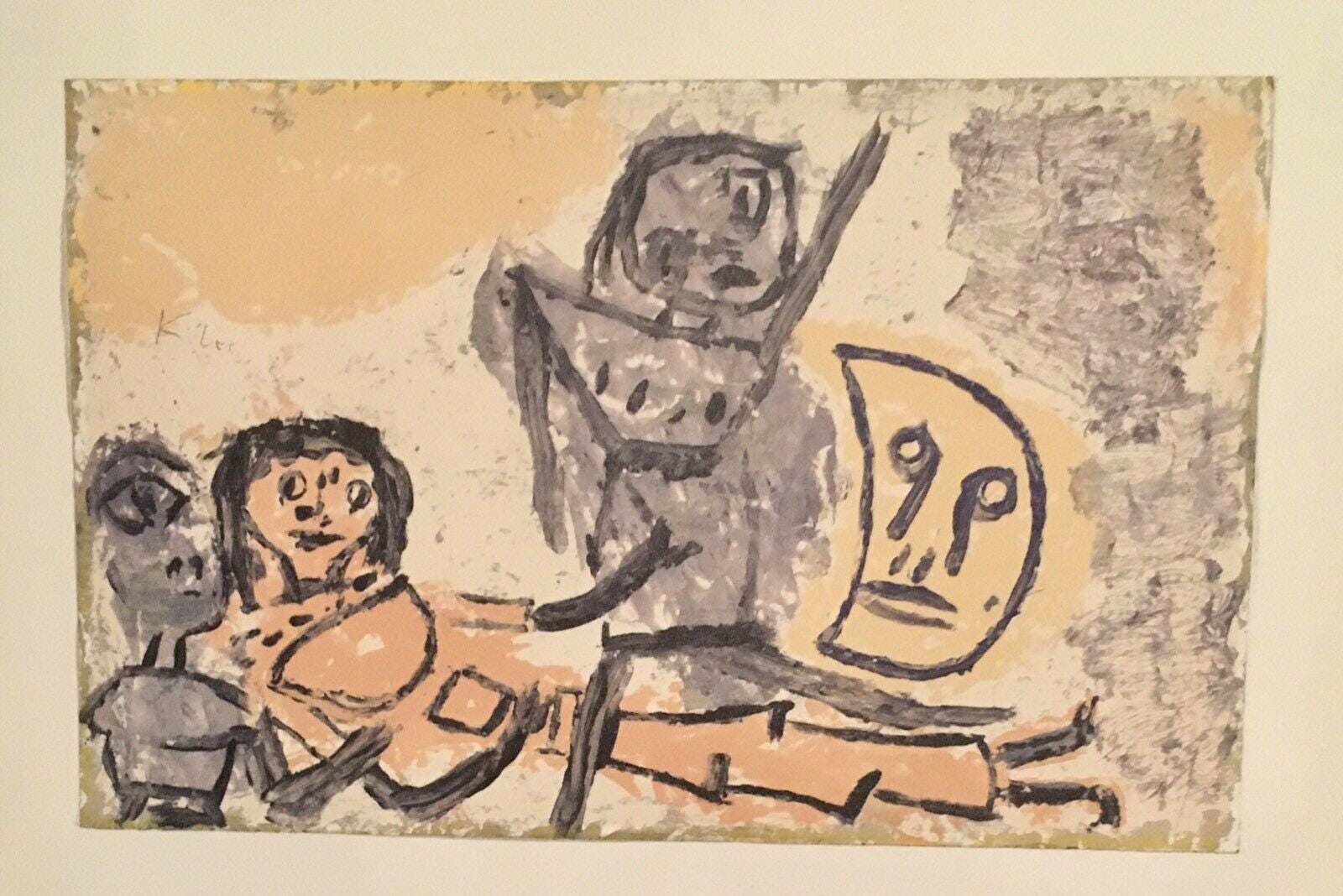
At dawn, the corncrake is practicing its crex crex call. The pewit answers in stilted beeps. Summer’s ooze filters through the early haze, flattening the crofts into gouache. Men are mishmoshing, in rough lines, through grass, wet enough to soak the sock in minutes. Someone is crouching at the hedgerow, bent double over the unseen work of chafer beetles, or hoverflies, devil’s coachmen, or earwigs. There is muttering, beneath the susurrus of the scythe mowers. The man’s mouth is weighing the palp of the thicket in the wet heat. Dog rose, chickweed, cleaver, vetch.
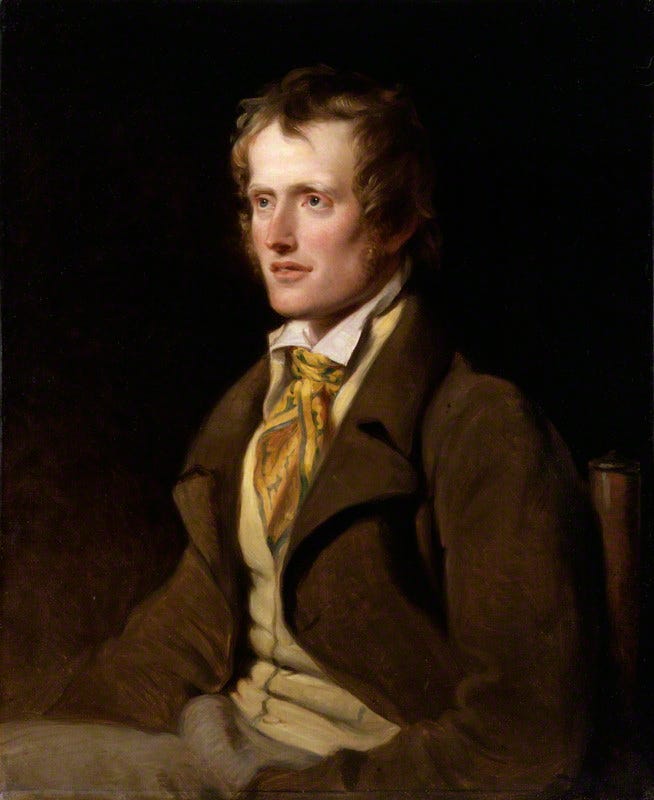
The mowers mow, lapping at the dense brush to the lazy beat of a summer work song. They have learned—not unkindly—to work around the man-shaped gap in their steady line. For every swish of the scythes, the man’s eye follows from afar:, metronomic. Left, pimpernel at the meadow edge. Right, ragwort in the ditch. Left, a yellowhammer on the gatepost, scribbling its tune. The figure straightens. He wipes his face with the back of a wrist and squints, reading the furrows of the next field over. Noting what has changed since last June and what has not. The gully border is a foot lower, a hole has been hacked into the far hedge, one corner of this damp green square is quieter than last year. Crex crex. John Clare picks up his scythe.
The mowers mow, lapping at the dense brush to the lazy beat of a summer work song. They have learned—not unkindly—to work around the man-shaped gap in their steady line. For every swish of the scythes, the man’s eye follows from afar. Metronomic. Left, pimpernel at the meadow edge. Right, ragwort in the ditch. Left, a yellowhammer on the gatepost, scribbling its tune. The figure straightens. He wipes his face with the back of a wrist and squints, reading the furrows of the next field over. Noting what has changed since last June and what has not. The gully border is a foot lower, a hole has been hacked into the far hedge, one corner of this damp green square is quieter than last year. Crex crex. John Clare picks up his scythe.
The son of a farm labourer who could barely read, and a mother who could not read at all, John Clare came of age in the very last years of the open fields system where the commons were still common. The parish of Helpston, a quilt, four miles square of rye and broadleaved wood cradled a life lived largely on foot; Clare hemming the fields and heathlands since early childhood. Sent to learn his letters in the neighbouring village, this formal education proved secondary to the knowledge gained from the hodgepodge of footpaths, drove roads and green lanes, tramped into the Northamptonshire soil. By the time he was a working labourer himself, he had accumulated a knowledge of Helpston Heath of such density and precision that it constituted something closer to a cognitive architecture than a set of passing observations. He knew the distinct scents of different barks after a wet month; the ragged textures of the scrubland untrod and overlooked by his neighbours. He leant loyally on the local dialect for an intimate knowledge of several hundred plants, birds and insects. This parochialism was a mechanism of distinct identity, preserving the fast-fading voice of English rurality. Clare fiercely rejected the grammatical enclosures favoured by contemporary publishers, once stating:
Grammar in learning is like tyranny in government - confound the bitch I’ll never be her slave.1
Clare’s names carried the particular topographical knowledge of how the country behaved: as a fecund network of unembellished functionality, transmitted by those who valued said function over taxonomic classification. A John Go Bed at Noon, tells one decidedly more about the flowering habits of the Scarlet Pimpernel than its Latin name Lysimachia arvensis. Clare’s breadth of knowledge was a kind only achieved through tactility. He walked the same ground repeatedly, mapping the horizons of his craft in parish borders: a cartographer of nesting sites, perennial flowerings and fledging spinneys of elm. In his autobiographical writings he describes childhood wanderings on Emmonsales Heath alone from the age of seven. It seems Clare’s preferred state was one of deliberate isolation, as he later would testify:
I find more pleasure in wandering the fields than in musing among my silent neighbours who are insensible to everything but toiling and talking of it and that to no purpose.2
A well-worn sole or two might sometimes be sighted protruding from a brush of sedge on a still day: the inadvertent naturalist lying with his chin in the dirt as to better observe the meanderings of pooties (common snails) or pismires (ants) for hours at a time. He noted the commutes of nature with the regularity of a phenologist, which is to say he was a phenologist, without the institutional apparatus or the gentleman’s leisure that natural history so often required. His method was his labour. The attitude that wends through his oeuvre is not one of unmaking the wonder--pinning the butterfly so to speak. Unlike contemporaries of the middle classes, the ‘peasant poet’ did not capture to turn over once in the hand and set back down. Rather, his work simply lived alongside the comings and goings of his patch of countryside. No need for embellishment when the life led is already so ordinarily wonderful.
Clare’s knowledge was calendrical before it was anything else. The rural year told the body where to be and what to find there, and the rest followed naturally. Pub balladry, market Sundays, the bonfire common at midsummer, flesh for the bones of an agrarian existence. The Shepherd’s Calendar, Clare’s 1827 collection, moves through the year month by month as faithful seasonal timekeeping, rather than idealised pastoral conceit. June is a set of tasks, a jumble of sounds, a bed of plants at a particular stage of flowering, a flock of birds and their distinctive habits. The knowledge is inseparable from its almanac, and the almanac is inseparable from its commons.
In Helpston, as in most parishes across Northamptonshire, midsummer had its own ritual economy. On or around the longest day, a clod of earth was turned up and stuck with whatever could be found pushing up through the sunbaked fields. St John’s Wort was particularly popular, blooming on St John’s Day—the solstice given a saint’s name and a feast—and the folklore was precise about what to do with it. Gathered before dawn, in silence, it was apotropaic. The Fuga Demonum of the folk practitioner, the square stalks would stand firm against various fiends as the wheel ground and the year began, however imperceptibly, its long descent into dark:
St. John’s Wort, scaring from the midnight heath
The Witch and Goblin with its spicy breath,3
so the folk proverb goes. Pressed into the clod alongside cyclamen, oxeye, lady smock, vervain, maidenhair, agrimony, the vegetal embroidery guaranteed safe passage through the remaining months. To Clare, this tradition was familiar as the Midsummer Cushion. It cost nothing, required no institution or permissive figure. Paraded down the parish thoroughfare and set atop windowsills, graves and lintels, the cushion simply necessitated common ground, common plants and the willing exchange of parochial knowledge.
The cushion was a compressed pharmacopoeia of the village green, carried to the door as a reminder of what the community collectively acknowledged. See what grows from free soil. One could not make a proper cushion without knowing which plants to use and could not know which plants to use without having walked the commons repeatedly, across years, unhindered. Rituals like the cushion were encoded assertions of common right. This was a community’s annual insistence that earth rejects singular possession enacted in the gathering of growth and its carrying from door to door. To fashion the cushion was to perform the commons; and to receive it was to accept them. The ritual was the tenure, renewed each midsummer in the damp tang of cut stems in June heat.
Ronald Hutton, in his seminal monograph The Stations of the Sun, is rightly careful about the antiquity of such customs—the evidence rarely reaches as far back as we would like, and much of what we think of as ancient tradition turns out, on examination, to be post-medieval at the earliest. But the cushion’s logic is older than its documentation. The gathering of midsummer plants at the solstice is one of the most widely attested practices in European folk culture. The broad folk record is littered with the same plants, the same timing and the same insistence that knowledge of the land is held in common and renewed by use. The Midsummer Cushion is a local inflection of something very old--the idea that the longest day is when the land is most potent, and that to gather from it on this day is to participate in something that asks, in return, to be passed on. In 1832, near two decades on from the last enclosure mandate at Helpston, John Clare named his manuscript collection of poems The Midsummer Cushion. His prefatory note makes clear the heft of the collection’s provincial title:
It is a very old custom among villagers in summertime to stick a piece of greensward full of field flowers and place it as an ornament in their cottages which ornaments are called Midsummer Cushions. And as these trifles are field flowers of humble pretentions and of various hues, I thought the above cottage custom gave me an opportunity to select a title that was not inapplicable to the contents of the volume.4
The cushion is Clare’s poetry figured firmly as folk object. A piece of common ground, worked and given freely, as recognition of solidarity shared in the customary behaviours of fellow working-class folk.
The standard account of enclosure is economic and it is true as far as it goes: the commons were privatised, the poor lost access to the grazing and gleaning and fuel gathering that had supplemented their wages and made subsistence possible. But the standard account does not go far enough into what enclosure did to John Clare specifically, which was to destroy his poetic cartography.
The classical and medieval rhetorical tradition understands memory as architectural, spatialised and anchored in real or imagined places, retrieved by cognitive ambulation through them. Stable spatial structures are essential to memory beyond mere backdrop. Remove the structure, and the knowledge does not become abstract or portable, rather it becomes inaccessible. There are certain things we might only know between one step and the next, learning so inextricably woven into space that to rearrange the terrain is to unwend the knowingledge itself.
Clare’s mental waymarkers were being uprooted and refigured as wattle fence, even as he wrote them. The soilskin of the hollows, hedges growing bilberry on their mistcatcher North sides. Enclosure halted old tracks and drained the wet ground. It grubbed out gullies of sump in place of muttons’ green wash pots. Clare’s world where
Unbounded freedom ruled the wandering scene
Nor fence of ownership crept in between
To hide the prospect of the following eye
Its only bondage was the circling sky5
was fast becoming confined to the boundaries of nostalgia. ‘sky-bound mores in mangled garbs’ were ‘left/ Like mighty giants of their limbs bereft.’ Clare could feel the genius loci of his home limping over the horizon, in search of ground not yet subjected to the surveyor’s ledger. In The Lament of Swordy Well, the heath lists what grew in it, what grazed on it, its tangle of use routes and shortcuts, each idiosyncrasy elegised by its dying host.
The silver springs grown naked dykes
Scarce own a buch of rushes
When grain got high the tasteless tykes
Grubbed up trees bank and bushes
And me they turned inside out
For sand and grit and stones
And turned my old green hills about
And pickt my very bones.6
Clare’s letters to his editor John Taylor from the late 1820s show the damage accumulating in real time. He describes not recognising paths he has walked since childhood. The landscape has been reorganised out of his cognitive reach and he is trying to walk it anyway following a nostalgic overlay. Down from Oxeye, over Cowper Green, through Butter Bump, Lolham Brook, Deadmoor--only in the mind.
Then, on the 21st of June — the solstice, the longest day, the day the midsummer cushion was carried from door to door — Clare wrote in his diary:
Reciev’d a letter from Taylor in which he says that there is twice as much more as he wants for the Shepherds Calendar. A few months back one of his causes for delay was that there was not enough to begin on. Nothing has made a wide difference here by time & left a puzzling Paradox behind it — which tells that he is a very dillatory chap. Recievd a letter from Mrs Emmerson with a Parcel containing a present of a waistcoat & some fine Polyanthus Brompton Stock & Geranium Seed.7
An enclosure in miniature. A London man, who has never walked Helpston Heath, tells Clare that The Shepherd’s Calendar contained too much local specificity, too much parish knowledge, too much shepherd, too much calendar. The Shepherd’s Calendar was heavily cut before publication. His unpunctuated syntax fenced and his parish names smoothed into general English. All dialectal knots were wrung out for a metropolitan readership, the collection’s lexical byways squared off.
Then Mrs Emmerson’s parcel. ‘Polyanthus, Brompton Stock, Geranium seed’. On the day the midsummer cushion moved from hand to hand across the parish, carrying the common plants to the common door, Clare receives seeds in the post. The seeds will grow and bloom and perhaps make it to germination. Taylor is taking things out of Clare’s manuscript. Mrs Emmerson is giving him things to put in the ground. A letter encloses. A letter plants. The solstice turns regardless.
John Barrell, writing about Clare’s relationship to landscape, argues that his poetry resists the picturesque tradition by encoding movement rather than prospect.8 His poems resist the half dimensions of the surveyor’s map and puts one within the experience of moving through. This is formally true and it is also the transmission mechanism. To read Clare, at the sweetest point of the English year is to be, briefly, a part of a collective knowledge preserved. Clare cannot write unadulterated pastoralism because the pastoral has been adulterated. The mode requires a stable relationship between the speaker and the worked landscape, and that relationship has been legally destroyed. What Clare writes instead is elegy that refuses to aestheticise its object.
Nearly a decade after The Midsummer Cushion‘s completion, Clare came lurching across these very same fields, crashing through newly planted hedgerows. Called away from a four-year stint at High Beach Asylum, Essex, by the voice of his long-dead lover Mary Joyce, he walked eighty miles over four days towards a home that no longer existed. The field boundaries had shifted, the old ways blocked by new enclosures. A fruitless pilgrimage scored by the sting of a sole macerated by toil in a standard-issue boot. The solstice since past, the year’s sweet spot embittered by the taste of roadside grass. Crex crex. The cushion browns over the lintel.
Letter 133, Edward Storey (ed.), The Letters of John Clare, (Clarendon Press, 1985).
John Clare: A Biography, Jonathan Bate, (Pan Macmillan, 2004), p. 240.
Plant Lore, Legends, and Lyrics, Richard Folkard, (R. Folkard & Son, 1885).
Ronald Hutton, Stations of the Sun, (Oxford University Press, 1995), p. 112.
Ronald Hutton, Stations of the Sun, (Oxford University Press, 1995), p. 112.
John Clare, ‘The Lament of Swordy Well’, in John Clare: Oxford Authors, ed. by Eric Robinson and David Powell (Oxford University Press, 1984), pp. 147–53.
John Clare, ‘21 June 1825’, John Clare Journal [blog], ed. by Arborfield, 2009
http://johnclarejournal.blogspot.com
.
John Barrell, The Idea of Landscape and the Sense of Place, 1730-1840; an approach to the poetry of John Clare, (Cambridge University Press, 1972), p. 13.
 | A guest post by
|
"At dawn, the corncrake is practicing its crex crex call. The pewit answers in stilted beeps." Scholarly prose with the pulse of imaginative literature. This is a lovely article.
I CANNOT believe I’d never heard of this incredible person. Your article has made me fall in love. Immediately adding him to my to-read. Thank you 🙏