
Sing the Legend
The Odyssey, Literacy, and Civilizational Collapse


by Roy Scranton
In 2022 and early 2023, as Americans shed their masks and began congregating in public again after the end of COVID-19, a strange phenomenon began to take shape. In a decision that was at once inspired counterprogramming and a snarky jab at Christopher Nolan for having gone over to Universal, Warner Brothers announced that Greta Gerwig’s postmodern, Mattel-driven Margot Robbie film Barbie would throw its hot pink weight up against Nolan’s massive biopic Oppenheimer, scheduling Barbie’s opening for the same summer weekend and setting up what seemed at first a battle royale between two visions of American dream life: funky, spunky, consumer-driven feminism against war, spectacular violence, and the moral burden of global power.
What happened instead was a cultural eruption almost Whitmanesque in its spontaneous embrace of oppositions: Barbenheimer! People wore pink fedoras, made memes, and bought tickets to see the two films back-to-back, arguing over which to see first. Both movies provided a feast for the eyes and much food for thought, and in dialogue generated a frisson that seemed like a once-in-a-generation event. But they weren’t just talking to each other: both films spoke to and through the history of cinema, from 2001 and The Wizard of Oz to Sidney Lumet’s Fail Safe and Andrei Tarkovsky’s Mirror.
This is how movies work. The light flickering on the cave wall entrances us, enraptures us, and we watch, dreaming en masse, longing to be subsumed into the fantasy we see projected on the screen. We want too much from movies, more than they can give us, more than we deserve, and certainly more than is really responsible. They speak not in words, but in movement and light, in a language formed from the history of images, in a dialect we call cinema.
Even though film doesn’t take up the same cultural space it used to—homebound entertainments like streaming and video games have displaced the experience of actually seeing a movie in a theater—we can’t quite seem to give up the expectation—or hope—that a movie might bring us together and give us something in common, even if only the same thing to post about on social media. The problem isn’t just the change in media and how we experience narrative in time. Concurrent with the proliferation of streaming images across every seemingly flat surface in our shared space, we’ve lost the understanding that cinema is a language each new film speaks and in speaking, changes. We’ve gotten so used to TikToks and clips and shows shot for people half-watching them on laptops while texting and scrolling that we’re losing basic collective cinematic literacy.
The response to Christopher Nolan’s blockbuster adaptation of Homer’s Odyssey is indicative. The film is ideologically parsed for how it serves the culture wars, pedantically derided for historical inaccuracy, and cheered as an example of how practical effects movie-making can survive and succeed in an era when digital heroes save digital civilizations in galaxy-sweeping stories that exist solely on hard drives. Then come the literary scholars. Classicist Daniel Mendelsohn, whose finely rendered translation of The Odyssey conveys both literary subtlety and a sense of aurality, as if the poem truly had just then been written down from a bard’s recitation, criticizes Nolan for making a Christopher Nolan movie, with a “tormented, guilt-ridden Odysseus” replacing the tricksy, murderous sailor in Homer’s epic. In his long review in the New York Review of Books, Mendelsohn grudgingly admits that yes, Nolan did a good job of recreating the temporal narrative complexity of its source material, but her finds that in the end Nolan’s adaptation is just too modern, too compressed, and too relatable.
Renaissance scholar Katie Kadue, writing in The New Republic, similarly pans Nolan’s Odyssey for resembling other films Nolan has made, particularly in its representation of Odysseus as “a basically good guy who feels bad.” Kadue criticizes Nolan for not delving into what she sees as his hero’s moral ambiguity, though it’s worth pointing out that, for Greek audiences, Odysseus’s willingness to lie, cheat, steal, plunder, murder, and brag wasn’t morally ambiguous at all, but perfectly acceptable. Though agreeing with Mendelsohn in her basic stance that Nolan’s Odyssey fails by modernizing and simplifying its source, Kadue differs in evaluating Nolan’s overall structure: she somewhat perplexingly denies that Nolan’s looping flashbacks do justice to the poem’s “disorienting temporal tricks.”
In what is perhaps the least generous review of Nolan’s movie I’ve seen (which is saying something), classicist Emily Wilson, whose pithy, blank verse translations of The Odyssey and Iliad have inspired both acclaim and criticism, damns the film with backhanded praise and writes that she “would be ashamed to have written any part of [the] script.” She doesn’t so much review the movie as run it down, taking every choice Nolan made and interpreting it in the worst possible light, granting nothing, making no effort to understand the film Nolan made, why he made it like that, and how it works as a piece of cinema. She has nothing positive to say about the film except that it might drive sales of her own book.
According to Wilson, Nolan’s Odyssey isn’t even as good as Uberto Pasolini’s turgid 2024 adaptation The Return, which picks up the story more than halfway through, in the middle of Book XIII, when Odysseus washes up on Ithaka. The Return is not without its merits, including the mesmerizing massacre of the suitors, but the films bogs down in scene after scene of stringy, dirty Ralph Fiennes staring dazedly at a hut wall. But comparing The Return to Nolan’s Odyssey is comparing apples and oranges, even though they have the same source material—you could just as well criticize Matt Reeves’s The Batman for not being Nolan’s Batman Begins. You might say Batman Begins is better, which I think is true, but it’s not very illuminating. What’s more interesting is what each version is doing with the material, how they relate to their time, and how each film takes up the language of cinema and tweaks it.
And this precisely is where Mendelsohn, Wilson, and Kadue go wrong. Nolan’s Odyssey draws on Homer’s poem for its source material, but Nolan isn’t talking to Homer. He’s not writing an epic poem or even a novel, and despite Wilson’s shame at being cited as an inspiration, anybody who’s spent any time thinking critically about film knows that scripts are secondary considerations at best. Spoken language matters, but the relative weight of the script as such is always only in proportion to the visual power of the moving images carrying the narrative. You could watch Nolan’s film on mute and still understand what’s happening—maybe even be moved by the action—because he’s a filmmaker of immense gifts for crafting intricate moving images in time.
It’s astonishing that neither Mendelsohn, Kadue, nor Wilson bother to even gesture toward the significant critical literature on Nolan’s body of work, which amounts to a fair-sized bookshelf, and even more astonishing—and disappointing—that they hardly mention any other films at all (except, of course, Nolan’s, entirely negatively, and a few other versions of The Odyssey, but entirely overlooking the countless films deeply influenced by the Odyssey, from Sturges’s Sullivan’s Travels to Godard’s Contempt). Reading these three scholar-critics, you would almost think no one ever made any movies besides Christopher Nolan, and that his films speak a narrow hermetic language only legible within the Nolanverse. The blinkered readings these three scholars offer go against the very spirit and responsibility of good criticism, which is obliged to balance evaluation with understanding, and which has as its sole authority a fluency in the form and language of the work in question. I’m baffled these scholars seemed to think they were qualified to write film criticism, or that their editors asked them to, when none of them seem to have any knowledge of film or any willingness to take their object of attention seriously as a work of art on its own terms.
Nolan’s Odyssey isn’t perfect. It’s not as good as Oppenheimer or even Memento, but I think it may be better than Inception. It’s a flawed but powerful work of cinema adapting a three-thousand-year-old poem to modern sensibilities and modern concerns. There are interesting things to say about how Nolan takes up and transforms Homer’s Odyssey, just as there are interesting things to say about how any cinematic adaptation works with and against its source material. But a film must be taken first and last as a film, just like a novel must be taken as a novel. Would Mendelsohn, Wilson, and Kadue condemn Joyce’s Ulysses because of the modernist liberties it takes with Homer? Or Hamlet because of the liberties Shakespeare takes with Saxo Grammaticus’s Gesta Danorum?
It’s true that Nolan leaves a lot out and changes Odysseus dramatically. He leaves out the year Odysseus spent sleeping with Circe after he threatened to kill her—he doesn’t even show Odysseus standing over Circe with his sword as she pleads for her life, as in Homer, but transforms that incipient rape into a standoff, with Circe’s metamorphosed sister and Odysseus’s changed men serving as hostages. Nolan leaves out how, when his aged nurse recognizes him, Odysseus takes her by the throat and threatens to kill her. He omits Odysseus ordering the butchery of Penelope’s maids, and Telemachus’s decision to merely hang them because they didn’t deserve clean deaths. Nolan leaves out how Penelope sleeps through the massacre of the suitors, how then Odysseus chastises her for being hard-hearted, and how she tests him with a trick about their bed. He leaves out the entire last book of The Odyssey, the poem’s proper conclusion, where Odysseus goes to his father Laertes, tests him with lies before revealing himself, then teams up with Laertes and Telemachus to fight the fathers of the suitors who’ve come looking for revenge. Odysseus throws a spear through Antinous’s father’s head, then leaps into battle, Telemachus by his side.
And now they would have killed them all, and given none of them
homecoming, had not Athene, daughter of Zeus of the aegis,
cried out in a great voice and held back all the company…
Athena strikes such fear into the suitors’ fathers that they drop their weapons and flee, but Odysseus, “with a terrible cry… like a high-flown eagle,” swoops upon them with murderous rage, stopped only by a thunderbolt from Zeus. I wonder what viewers would have made of an “authentically Homeric” Odysseus, an unrepentant killer whose rage can only be checked by the gods. Homer’s πολύτροπον ἄνδρα is for us an alien, violent man from an alien, violent world, in which women were chattel, thoughts came from gods, and virtue meant being a ruthless and effective killer.
But focusing on what Nolan leaves out is an exercise in sterility. Better to ask what Nolan’s doing, how, and why. First of all, we have to understand that Nolan’s Odyssey is a big, mainstream Hollywood movie. He’s aiming at a global audience, from Waukegan to Shenzhen, and he’s working not in the idiom of literature but in the idiom of film. Moreover, he’s addressing a post-literate audience who spend more time scrolling and swiping than they ever do reading or even watching movies. And he’s addressing a time of fractious, politicized global upheaval, a time wracked by climate change, war, economic disparity, and destabilizing technological transformation.
Making a blockbuster movie out of The Odyssey is a real challenge. Your hero can be morally ambiguous, within limits, as long he has a core of integrity, but he can’t be bloodthirsty or savage, like the warriors we find in Homer. He might be wayward or vulnerable, but not callous or slutty, which is why Nolan’s Odysseus can be seduced by Calypso but can’t randomly sleep with Circe just because she’s there. And he can be subtle and strategic, but he can’t be an out-and-out liar. Homer’s hero sometimes seems to make up stories for the fun of it, which is interesting, but wouldn’t fit with the kind of story Nolan’s telling, which is about a soldier who wants to get home. And that’s the crux of it: as Mendelsohn points out, citing Aristotle, the narrative core of Homer’s Odyssey is the story of a man coming home “after a storm-tossed journey” to find that home invaded by men who aim to marry his wife and murder his son. As Aristotle writes, “That is the essential; everything else is episodes.” Recognizing this, even ancient Greek playwrights took liberties with Homer, in ways that make Mendelsohn and Wilson’s complaints seem pedantic, even puritanical.
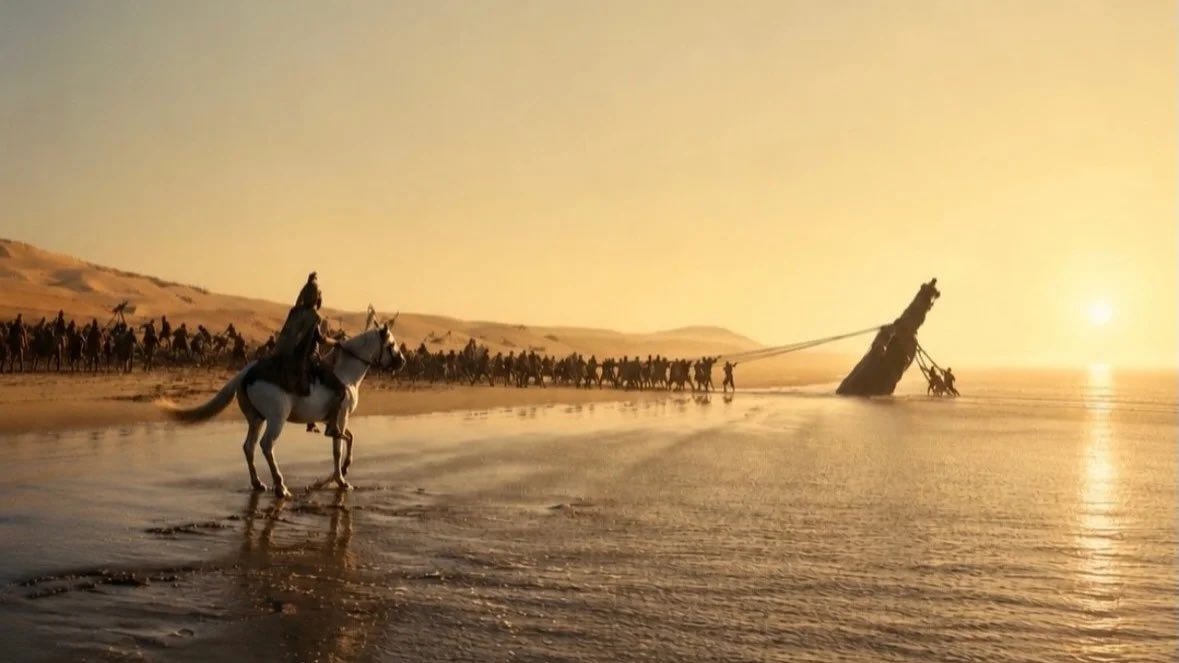
So what’s Nolan doing with this story? More than I can say in this short space. But reading The Odyssey through the language of cinema would be a good place to start. Nolan’s Odyssey is deeply referential, with nods to The Planet of the Apes, Tarkovsky’s Andrei Rublev, and Elim Klimov’s harrowing Come and See, but it works primarily, I would argue, within three main cinematic genres, which it interestingly and provocatively combines and transforms: the historic epic (particularly the sword-and-sandal subgenre), the homecoming film, and the Western.
The ways in which Nolan’s Odyssey calls back to Ben-Hur and Spartacus, as well as Ray Harryhausen B movies like Jason and the Argonauts and Clash of the Titans, is fairly obvious, but it’s also worth noting how Nolan filters the Greek adventure story through Roman (and even Biblical) epic. Perhaps the key element here is Nolan’s christianizing of the Homeric myth. Damon’s Odysseus must redeem himself through submission to the gods, a baptism that is also figured pictorially as a kind of crucifixion, a confession (given through a screen, no less), and a passion, which begins with the beating he takes as a beggar and continues through the massacre of the suitors, where he is pierced with various weapons and almost overcome. Scholars have written on the theological tendencies and implications in Nolan’s work, and other critics have commented on the Christian or even Catholic coloring of his Odyssey, but I think it may be most productive to see these tendencies here as working through cinematic genre. Perhaps the most intriguing twist Nolan offers with regard to this genre is something that connects The Odyssey to the Western, as well, which is how it ends. I’ll say more about that in a minute, but first let’s take a look at the genre of the homecoming film.
There are lots of movies about veterans, but not all of them are homecoming movies. The homecoming movie is a specific genre that deals with two related problems: first, the need to narrativize the experience of war in peacetime, and second, the domestication of the violent man. Trauma is central to both. As I’ve argued elsewhere, the idea that the experience of war should be understood primarily or even exclusively as trauma emerges first in the early nineteenth century but really takes hold after World War I, in Europe, and in the 1960s, in the United States. As late as 1970, a movie like Patton could still seriously portray war as a field of action for human achievement and be rewarded for it, but the dominant tenor changes in the 1970s with films such as Johnny Got His Gun, Coming Home, Apocalypse Now!, Taxi Driver, and The Deer Hunter. These films, and later homecoming films such as Born on the Fourth of July and American Sniper, looked back to a range of movies making sense of veterans returning from World War II, including various film noirs and Westerns (and neo-Western noirs like Bad Day at Black Rock), dominated by the acknowledged masterpiece of the genre, The Best Years of Our Lives (1946).
The Best Year of Our Lives tells the story of three veterans coming home from the war, an air force bombardier, a soldier, and a sailor. They’re all returning to the same town, Boone City, and meet up at an airport where they catch a ride in a bomber being flown to be decommissioned. William Wyler’s powerful juxtaposition of wartime experience and hometown return takes shape first in the three men’s view of the American heartland from the targeting reticule of the bomber they fly in. The arc of the film will be for each man to subordinate their wartime selves to the constraints of civilian life. What growth their war experience might offer is more of the character of maturation and disillusionment than insight or transcendence. These characters aren’t heroes on a Campbellian quest where their journey to Hell gives them wisdom, but rather more like wayward souls who must be redeemed. Each character typifies a challenge the veteran faces: the sailor (played by Harold Russell, who lost both hands in the war) is physically disabled; the soldier finds himself caught between the competing ethical demands of military fraternity and commercial bureaucracy; and the airman struggles with both psychological trauma and a sense of personal diminishment, having traded the status and power of aerial bombing for jerking sodas at the corner store.
The film’s core narrative is what connects it most powerfully to Nolan’s Odyssey: as critic Robert Warshow pointed out, The Best Years of Our Lives dramatizes the feminine domestication of male violence. In its social resonance, the 1946 film was immensely powerful, ranking as one of the top box office hits Hollywood ever produced before 1950 and sweeping the Academy Awards, winning nine Oscars. But as ideological interpellation, it served a crucial function, reintegrating in fantasy the millions of real veterans struggling to fit back into civilian life. This is one way art works, by giving aesthetic form to actually existing contradictions.
Nolan’s Odyssey is true to its genre. As Damon’s Odysseus struggles to make his way home, his biggest challenge isn’t the threat of giants and witches, but the need to integrate his experience of violence into the civilian world and submit his masculine energy to feminine domestication. The key to this through-line lies in the close connection between Penelope and Athena established through the pin that Penelope gives Odysseus, which serves not only as a narrative reminder of Odysseus’s goal, but as a symbol of feminine power. What’s more, Odysseus’s devotion to his wife and home have a kind of secularizing force in the film. Against Agamemmnon’s sacrifice of his daughter to the gods and Eurylochus’s superstitions, Odysseus’s practical devotion to Penelope (figured through Athena) seems almost monotheistic or atheistic in character. And indeed, the traumatic memory that burdens Odysseus with the greatest guilt isn’t his lies or even the Trojan Horse, but rather the twin beheadings of the statue of Athena and her priestess, played by Zendaya, whose form Athena later takes. To see Athena’s head cut off is to see his own connection to home severed; to see the priestess killed is to witness Penelope’s own death; “to burn Troy,” Odysseus confesses, “was to burn the world.”
This is powerful cinema, but entirely un-Homeric. It’s not, however, alien to the Greeks. This aspect of Nolan’s Odyssey calls to mind Aeschylus’s Oresteia or Euripides’ Medea rather than Homer’s poem. Like these plays, Nolan dramatizes a protagonist’s inner conflict between competing ethical claims and the submission of primeval loyalties to universal laws. In Nolan’s Odyssey, the violence of Agamemnon and Menelaus loses out to the peace Odysseus wins through self-sacrifice: in going into exile with Penelope, Odysseus surrenders his kingship to the Law of Zeus and subordinates any claim to future glory both to Penelope’s fantasy of escape and the collective demand that he honor the death of his fellow men. Thus we can understand Nolan’s Odyssey as a civilizational narrative, a story of moral and cultural progress, in dialogue with Aeschylus’s version of the Oresteian counter-narrative working through Homer’s Odyssey, as well as with that genre of American cinema most devoted to the idea of progress, the Western.
Countless Westerns play off The Odyssey, so in a way Nolan is returning the favor with his sweeping landscapes, western exile, ocean voyage as stagecoach ride, and quick-shooting bow-slinger hero. The Searchers, in particular, weighs heavy on the film, as it does on much of American cinema, with its complex meditation on violence, guilt, and homecoming, as well as the decision to end with the violent man’s exile from the civilization he saved by his violence. As scholars have noted, The Searchers can be read as a western Odyssey, so it’s not much of a stretch to see Nolan’s Odyssey in dialogue with John Ford’s film and Damon’s Odysseus as a version of John Wayne’s Ethan Edwards. There’s more to say about this, but I want to conclude by looking at one of The Odyssey’s more unexpected intertexts, which it alludes to at its end, and which complicates its civilizational narrative.
After Odysseus massacres the suitors, he collapses before Penelope, grievously injured, perhaps on the brink of death, but his words carry us across a cut that reveals crowned Telemachus standing on the shore with the people of Ithaka, watching a ship depart. Odysseus and Penelope are sailing west to exile, but not to oblivion. Their story will be remembered. “We broke the fragile bonds between men, and for centuries to come the story of Troy would only be sung,” Odysseus tells Penelope. Why sung?, she asks, and he answers, “Songs will be all they have to remember us who could write.”
The invocation of literacy and Linear B at the film’s close, when we’ve seen no indication of writing up till then, feels pointed, puzzling, and jarring. It resonates with the theme of civilizational decline threaded throughout the film by the rumors of the Sea Peoples and articulated in Odysseus’s confession to Penelope, where the film suggests that the Greeks themselves were, in some way, the People from the Sea. Nolan here plays with history the way he played with physics in Interstellar, or dreams in Inception, going beyond the limits of the known to imagine exciting possibilities.
Contemporary scholarship understands The Iliad and The Odyssey to be written versions of oral poems composed by one or more bards sometime in the eighth century BCE which describe a more complex and wealthier society than existed in Greece at the time of the poems’ composition. Thanks to the obsessive, reckless efforts of Heinrich Schliemann and the more sober archaeologists who followed in his wake, we have archaeological evidence of both a powerful, advanced, and literate Greek society centered in the Peloponnese with capitals in Mykenae and Pylos and the destruction of a city on the Turkish coast, which correlate roughly with the supposed chronological framework of the Homeric poems and seem to suggest that The Iliad and The Odyssey preserve in some fashion the memory of that society and its war with an eastern foe. Today you can visit ruins in Mykenes, Pylos, and Ithaki that are, thanks to Schliemann, still called the palaces of Agamemnon, Nestor, and Odysseus, though we have no clear record of who lived in them. What written records have been preserved in Linear B, the written language of Mycenaean civilization, are mostly bureaucratic accounts of stores, taxes, and troop dispositions.
What happened to Mycenaean civilization is a mystery. Its collapse in the 12th century BCE coincided with widespread destabilization across the eastern Mediterranean, caused perhaps in part by climate change, natural disasters like earthquakes, war, and migration. As archaeologists often observe about civilizational collapse, it’s difficult to separate cause and effect. The written records at Pylos, which only survived because the palace was burned, suggest a sudden catastrophe, perhaps an invasion. Egyptian records from the time attest to a mysterious “People from the Sea” pillaging and conquering all up and down the coasts.
Nobody really knows what happened, and Nolan bends this mystery to brilliant effect. For as much as his Odyssey is an optimistic civilizational narrative and his Odysseus a civilizational hero, preserving law and order in the face of barbarism, it’s also a narrative of civilizational collapse and a pessimistic story about the persistence of human violence. For while the film suggests that Odysseus identifies himself and his men with the People from the Sea, it also ends with Odysseus foreseeing the collapse and decline those Sea People may have helped cause. What’s more, adding another layer of complexity and contradiction, Odysseus’s final line, “Songs will be all they have to remember us who could write,” evokes the end of John Ford’s classic Western, The Man Who Shot Liberty Valance.
Perhaps one of Ford’s most important films, The Man Who Shot Liberty Valance tells the story of how a virtuous young lawyer, Ransom Stoddard (Jimmy Stewart), confronts a notorious outlaw named Liberty Valance (Lee Marvin) in the unincorporated frontier town of Shinbone, faces him man to man, and defeats him in order to establish the law, win an election, and bring the territory into the fold of civilization. The twist is that Valance isn’t killed by Stoddard, even though that’s what the townspeople think. In fact, a rough-hewn rancher named Tom Doniphon (John Wayne) shot Valance from afar, in the back, with a rifle. The heroic narrative upon which American civilization and Ransom’s career was founded, we learn, is a lie. Yet when a reporter later uncovers this truth, his editor squashes the story, saying “When the legend becomes fact, print the legend.”
Ford’s complex meditation on originary violence, civilizational narrative, politics, and American identity is echoed in Nolan’s meditation on narrative, identity, and collapse in The Odyssey. From the beginning of the film, with Travis Scott’s bard chanting “A face. A fleet. A war. A man. A thought. A trick… A trick to break the walls of Troy!,” to Menelaus asking Telemachus if he’s heard what it was like “on the inside,” from Odysseus’s painful efforts to remember what happened at Troy to his disguised discussion with Penelope about the stories he’s heard people tell about it, Nolan troubles our sense of narrative stability, working against the authority of the moving image to make us question just what we know and how we know it. Odysseus’s ambiguous prophecy at the film’s end, that future generations would “sing the legend,” reminds us somewhat pointedly of how factitious Homer’s narrative is. If there really was an Odysseus, he’s not the πολύτροπον ἄνδρα Homer sings of, but something even more complicated: a man, a legend, a story. Was there an Odysseus? Was there a Troy? And what will future generations say of us when songs are all they have to remember?
This ending tries to hold too much together. Nolan’s Odyssey doesn’t quite cohere, though it feels at times so close that the yearning for a sense of resolution itself seems part of the experience. Perhaps this too is part of the film’s achievement. Like Nolan’s other work, The Odyssey is playing with time, meaning, and narrative, troubling our sense of what we think we see. Behind the tension between progress and collapse dramatized in the conclusion of Odysseus’s narrative lies another tension, at work throughout the film, between civilization and violence, which isn’t binary but more recursive and dialectical. While Odysseus struggles to keep faith with the practical crafts and technology of the domestic, the bronze pin of Athena, Penelope’s loom, his wooden ship, another vision of civilization echoes through the film in the black armor of Agamemnon, the anachronistic iron plate of the Laestrygonians, and the improbably realistic form of the Trojan Horse. In this, as other commentators have noted, Nolan is reprising concerns about the dangerous effects of technology he’s articulated throughout his career, from The Dark Knight and Inception to Tenet and Oppenheimer. The difference here is that in The Odyssey, our capacity for turning technological innovation to violent ends isn’t a product of modern civilization, but a characteristic of civilization as such.
Some viewers may reject such pessimism or find it too threatening to be palatable. Similarly, the spectacular physicality of Nolan’s filmmaking may leave some viewers cold. Emily Wilson writes how she “gazed at the shipwrecks and bloodbaths without any agony of emotion,” and de gustibus non est disputandum. I, for one, was thrilled by the photography of crashing seas, arcing dolphins, and sweeping coasts, and wowed by the practical effects and real ships and read men. The location filming in Greece and Italy was powerfully immersive, especially with the Cyclops’s cave, and the camerawork around Penelope’s loom gorgeous. Compared to similar fantasy stories like HBO’s House of the Dragon, which while sophisticated and well-produced can’t quite escape the tackiness of its digital world and soap opera plot, Nolan’s Odyssey looks like an art film. It’s fresh, bold, and more than the sum of its parts, just like its Homeric source material, and if it doesn’t quite achieve cinematic perfection, it’s definitely worth seeing on the big screen and thinking about with a generously critical and sympathetic imagination.
This is how movies work. The light flickering on the cave wall enraptures and we watch, dreaming en masse, longing to see our contradictory fears and desires projected on the screen. We want too much from movies, more than they can give us, more than we deserve, and certainly more than we might responsibly ask. They speak in a language formed from the history of images, in a dialect we call cinema. If we can read it, the art transcends escapism and becomes a form of self-reflection. But if we lose that language, if we become illiterate in our own culture, then we’ll likely soon see ourselves as strangers—or maybe we already do.
 | A guest post by
|
This is a great review