
Easter Omelet
In the key of spring


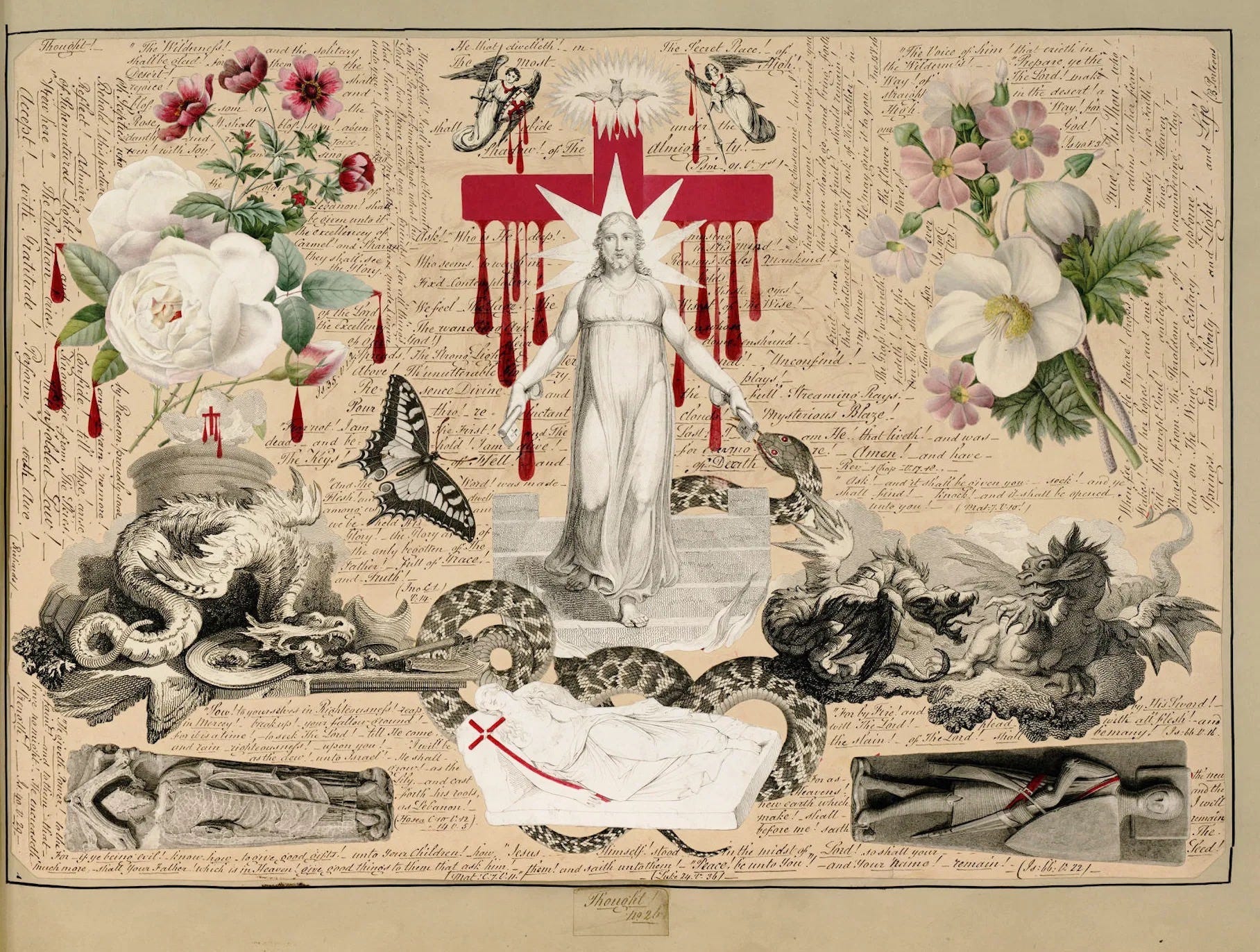
I worked at a New Mexico diner that served lamb omelets on Easter Sunday for the churchgoers after mass, a plate of sacrificial lamb and vernal eggs. I resolutely announced the daily special as “Lamb of God Omelet.” No one blinked. Doubling down, I would ask if they wanted it smothered in red chile sauce, meaning it would arrive like a pool of blood. “Yes please.”
I too prefer to stew in complexity, so let us now dissect the omelet: this lamb’s-blood-drenched holiday of death and underworld sermons and hope and springtime and an egg-laying rabbit. And, of course, a busty blonde flower-wreathed hallucination named Eostre.
Easter is not so simple as a Christian holiday being slapped on top of a pre-existing pagan holiday.
The early Church was syncretic from the start. Christianity was a new sect of Judaism, and there had been others before it: Pharisees, Sadducees, Essenes, Zealots; many men had claimed to be the Messiah, how was this any different? For centuries some Christians continued to observe Jewish dietary restrictions and practiced circumcision. The process of differentiation between Christianity and Judaism was long and intricate; certain family members might convert and not others, traditions were continued or redefined or abandoned; it was not a swift rupture by any means, but rather an ongoing process of conversation and conflict.
As Christianity took hold in the Roman Empire, it jostled among the various Hellenic faiths of the Near East and Mediterranean, notably the so-called mystery religions of Egyptian Isis, Persian Mithras, and Anatolian Cybele and Attis, the Greco-Roman pantheon, as well as Gnostic beliefs that emerged concurrently with Christianity. During this time, the New Testament canon was developed. Disagreements over texts and tenets abounded within the early Church, and ecumenical councils were held to iron out the details. Meanwhile, pagan.1 practices continued alongside Jewish practices alongside Christian converts’ practices.
As a new religion, Christianity was continuously having to create and defend its moat – that which defined it as unique – both from its parent Judaism and from the polytheisms surrounding it in Rome and beyond. As Christianity expanded first into Asia Minor and North Africa, and then into Anglo-Saxon, Germanic, Gallic, and Celtic lands from the 3rd-8th centuries, conversion was piecemeal and incomplete. Many converts would continue worshipping their local gods alongside the new faith. A region might convert to Christianity under one ruler only to convert back when a pagan leader took power. Seasonal festivals and rituals continued to be celebrated. It was difficult for the Church to budge the inertia of social habit—people liked their gods, domestic shrines, habits, rituals, and most of all, their holidays. Throughout all of this, Church doctrine and practice remained in flux and under discussion.
Christianity did not form in isolation: it was always a product of interaction, argument, negotiation, and compromise. There is perhaps no better illustration of this than Easter. Lamb of God omelet, coming right up.
Origins: Passover
Passover celebrates the freeing of the Israelites from centuries of slavery in Egypt. Pharaoh refused Moses’ requests for his people’s liberty, so God unleashed ten plagues upon the Egyptians. Before the final plague, the death of firstborns, the Israelites were warned by God to slaughter lambs and mark doorways with their blood so the Angel of Death would pass over their houses. The Israelites then fled Egypt. To commemorate the liberation and exodus, unleavened bread/matzah (to symbolize the hurried departure) and bitter herbs (a reminder of the bitterness of slavery) are eaten as part of a communal meal of wine, meat, and the retelling of the Exodus story. Passover is always celebrated on the full moon following the vernal equinox, on the 14th or 15th of the month of Nisan.
Passover was originally the New Year’s holiday of the Jewish people (later, Rosh Hashanah, an autumn holiday, became the principal Jewish New Year and is celebrated as such today). Indeed, most cultures of the Middle East and Mediterranean celebrated their New Year in the spring—in the exilic and post-exilic periods of the Jewish people, the Babylonian calendar was the norm, and Jewish scribes would have been quite familiar with the Mesopotamian springtime New Year festival, Akitum, and its older precedent Zagmuk.
Akitum celebrated the sprouting of barley and the triumph of the young god Marduk over the ancient seamonster-goddess Tiamat. Festivities included reenactments in which Marduk would depart to the Akitu-house outside the city gates and then have a triumphant parade back into the city on the final day of the festival. Meanwhile, the temple was ritually cleaned with fire, water, and sheep’s blood. The festival started on the new moon after the spring equinox and lasted twelve days, meaning its final day would fall around the same time as the later Passover feast. Zagmuk, Akitum, and Passover all took place in the first month of the year, Aviv, which later came to be known as Nisan in the Jewish calendar.
There is scholarly debate on the relation of the Passover celebration to these preexisting Mesopotamian springtime agricultural festivals. The Book of Exodus explicitly mentions barley sprouting and lambs, indicating springtime, but it is postulated that the Exodus memory was already linked to Mesopotamian agricultural festivals by the time its annual timing was codified and the story was written down in the 7th century BCE. While the Jewish holiday commemorates a historic event, it is considered plausible that its celebration built on a pre-exilic ritual framework, as these springtime festivals were well-established in the Middle East at the time when the Torah was written. That said, I do not believe cross-cultural rhymes like this are necessarily direct borrowing; rather, people living in the same region, hearing one another’s stories and living in a similar climate, might simply be within the same mythological musical scale and unconsciously partaking of one another’s themes and narrative elements. This is particularly true of seasonal celebrations.
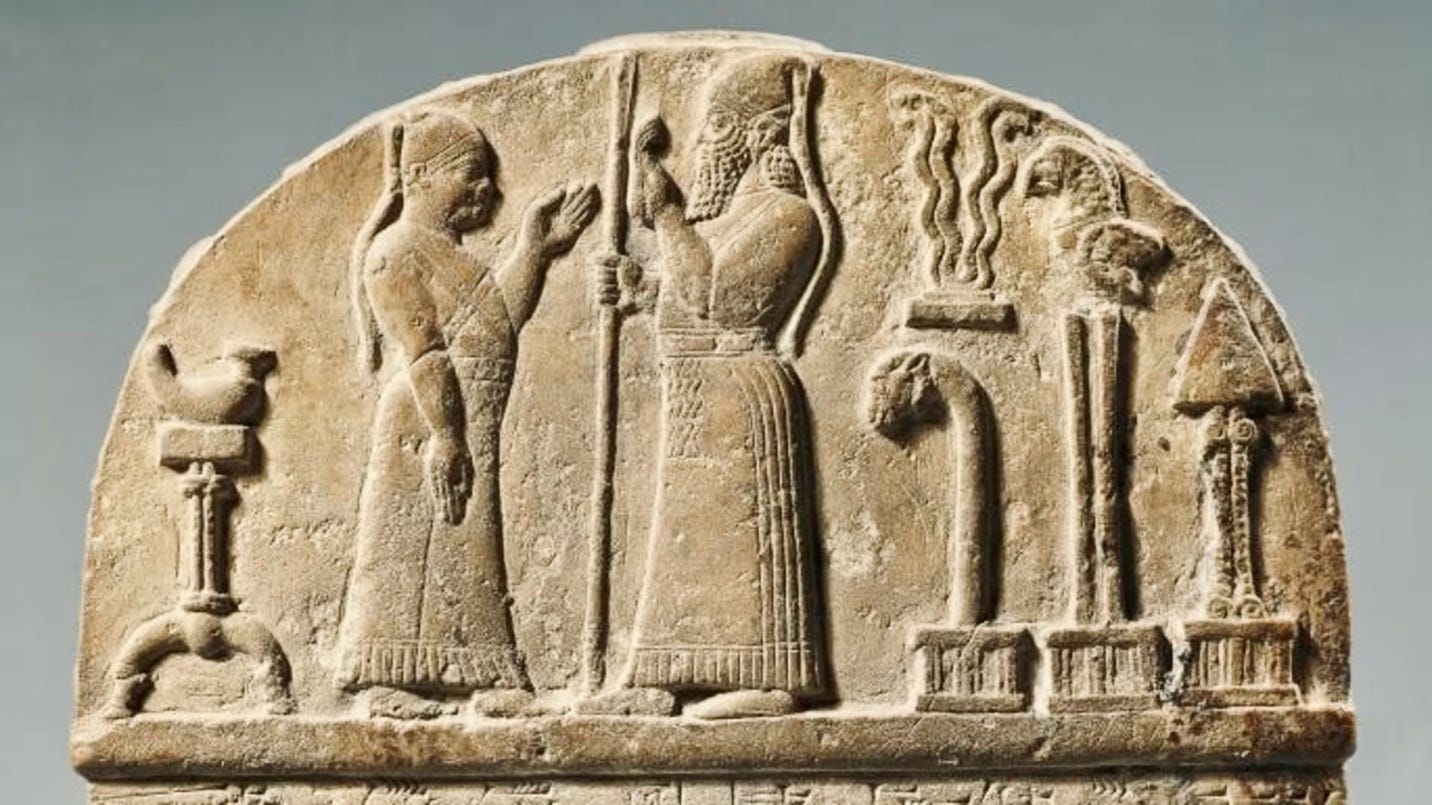
Easter is tied to Passover and Passover may have echoed earlier Mesopotamian festivals; there is shared Middle Eastern springtime symbolism among all of these holidays. If we’re going to speculate about any ancient pre-Christian origins of Easter, we should be looking not to a Germanic pagan goddess Eostre with her bouncing bunnies and bountiful eggs (more on her to come), but rather to Mesopotamian Marduk dueling seamonster Tiamat among the sprouting barley and slaughtered lambs.
On the date of Easter
Passover is always the first full moon following the vernal equinox. Easter is the first Sunday after the first full moon following the vernal equinox. In 2026, the equinox falls on March 20th, the first full moon after it is April 1st (Passover starts that evening), and Easter lands on Sunday, April 5th.
Jesus was crucified on Passover, so the story of his resurrection is intrinsically linked to the Jewish holiday. Christian theologians interpret the Passover lamb as prefiguring Jesus’ crucifixion and the Jewish exodus from slavery in Egypt as foreshadowing Jesus’ liberation of humanity. Passover, or pesach in Hebrew, is the origin of the word Pascha. Most of the world still uses this same root to refer to Easter: Spanish Pascua, French Pâques, Italian Pasqua, Russian Paskha.
Early Christian paschal celebrations were on Passover itself and focused on Jesus’ death, not his resurrection. But even as Christian theology developed from Jewish antecedents, it sought to reject contemporary Judaism, and having Easter’s date on Passover felt problematic for many early Christians. While churches of Asia Minor preserved the most ancient form of the paschal feast (on Passover), others decided it must instead be celebrated on the Sunday after Passover. Those that continued to celebrate on Passover were nicknamed the Quartodecimans (“fourteeners” after the date of Passover, which falls on 14 or 15 Nisan, depending on the timing of the full moon). Bitter sectarian debate ensued. Pope Victor attempted to excommunicate the Quartodecimans, but various bishops interceded for the sake of church unity.
It was eventually decreed by Emperor Constantine at the Council of Nicaea in 325 CE that the paschal feast must only be celebrated “on the Lord’s day,” i.e., the Sunday after Passover. Unfortunately, Constantine did not attach a paschal calendar to the Nicene decree, and the churches of Alexandria and Rome, using separate calendar systems, assigned the equinox to different dates. There was ongoing difficulty, frustrations, countless paschal tables, letters, and councils among popes, bishops, and clergy to determine the proper date of the holiday.
This was all largely ironed out in 1582 with the widespread adoption of the Gregorian calendar, although the Eastern Orthodox church persists in using the older Julian calendar. In 2026, they will be celebrating on April 12, not April 5, so, clearly, the Easter date debate is not dead but rather quite alive and well.
The Ostara fallacy
Perhaps you’ve heard of Eostre/Ostara? The pan-Germanic pagan goddess that inspired Easter? With her totem animal the rabbit and basket of eggs symbolizing fertility?
I hate to break it to you, but I don’t think she’s real.
Let us examine the evidence. The Venerable Bede, an 8th century monk and scholar, listed all the Old English names of the month, including such bangers as Blodmonath (November, the month of bloody sacrifices). The entry for April read:
“Eosturmonath has a name which is now translated ‘Paschal month,’ and which was once called after a goddess of theirs named Eostre, in whose honor feasts were celebrated in that month.”
Bede, De temporum ratione, 725 CE
This is the sole textual evidence of the pre-Christian Germanic goddess Eostre. Many scholars consider Eostre’s entire existence to be an “etymological fancy on Bede’s part.” Some claim that the name of the month is a botched translation of the Latin term albae for dawn (into Old English ēastre and Old High German ôstarun), as in the dawn of the year, springtime.
From Bede’s one sentence offhandedly mentioning Eostre, Jacob Grimm further fabricated in Deutsche Mythologie (1835):
Ostara, Eástre seems therefore to have been the divinity of the radiant dawn, of upspringing light, a spectacle that brings joy and blessing, whose meaning could be easily adapted to the resurrection-day of the Christian’s God.
Perhaps there was an Eostre. Or perhaps the Venerable Bede made her up and Grimm fluffed her myth and renamed her Ostara. Seasonal festivals were common across Northern Europe, and rites of spring were of course included, and perhaps there were bunnies and eggs, maybe even a goddess involved... but this is all speculation.
This has not prevented her neopagan admirers from supplying plentiful online images of her (just do a quick search) and fanciful interpretations of her cult and festival. According to one website: “Easter eggs and the Easter Bunny both featured largely in the spring festivals of the goddess Ostara. The rabbit (famous for its skill at rapid reproduction) was her sacred animal and brightly colored eggs, chicks, and bunnies were all used at festival time to honor this goddess of fertility and abundance.”
A more likely explanation: As Christianity began to spread into northern Europe in the 6th- 8th centuries, the paschal feast was referred to by the month in which it most commonly occurred, April, Eostremonath. Everywhere else, it continued to be called “Pascha,” as is still the case in most of the world today.
What are people reaching for when they embrace Ostara? A flower goddess is certainly more attractive than bishops arguing over a calendar. But deeper than that: it is an appealing notion that Christianity is downstream of something earthier and older—which it is, of course, but the genealogy is not so tidy.
But what about the bunnies and the eggs
Eggs were prohibited during the forty days of Lent,2 but this did not stop chickens from laying them. This resulted in a backlog of eggs. When the fast ended on Easter Sunday, there was thus much egg-gifting and -eating. As standards of living rose above subsistence, Easter eggs transitioned from pure foodstuff to festive gifts and were dyed, decorated, and rolled down hillsides by children. The most popular means of dying the eggs was boiling them with onion skins, which rendered them yellowish.
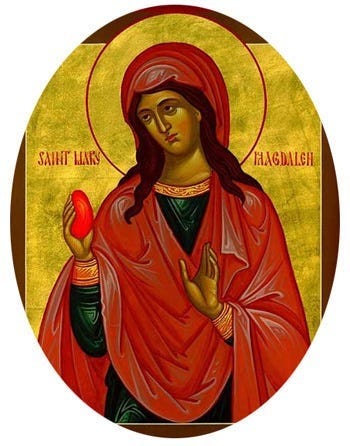
There is also a tradition within the Orthodox Church, in which Mary Magdalene appeared before Emperor Tiberius Caesar and proclaimed “Christ is risen!” at which Tiberius scoffed that Christ rising from the dead was as impossible as the egg Mary was holding (she happened to be holding an egg, I suppose) would turn red; the egg immediately turned red. Accordingly, in Greek and Slavic celebrations, Easter eggs are dyed red, not pastel colors.
None of this explains the egg-laying rabbit. Nor does our hallucinated goddess Eostre. Instead, the Easter Hare (der Oster-Hase) was a 17th century Germanic folk tradition. But wait, I hear you saying. Could the Germanic folk tradition be an ancient pagan rite connected with a goddess of springtime… is Eostre real after all?? Such a thing is possible, I suppose, but there is certainly no evidence for it. The first record of the Oster-Hase is 1682: children built nests for the Easter Hare, who duly delivered eggs to good children like a springtime Santa Claus. There is no historical tradition of an ancient pagan springtime hare deity.
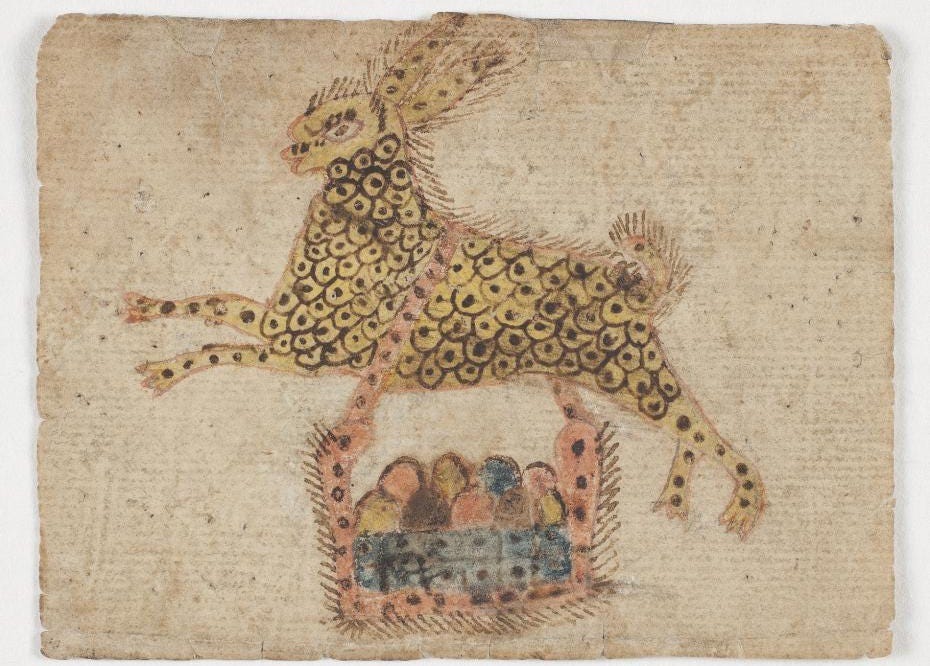
The Easter Bunny immigrated to the United States with German families and was popularized among Pennsylvania Dutch communities. And it took off—by the early 1900s, the egg-laying Easter Rabbit was widely popularized in newspapers and advertisements, and egg hunts were organized for children.
As the 20th century progressed, toys and advertising became increasingly central to holiday culture. Easter’s commercialization focused almost entirely on rabbits and eggs. To be fair, there’s not much you can sell depicting a resurrection except perhaps a jack-in-the-box or a Pop Tart. Stuffed lambs are sometimes sold, but that feels a bit grisly considering the lamb was originally slaughtered to have its blood smeared on a doorway. Instead we have fluffy bunnies, chocolate eggs, jellybeans, and Peeps.
He has risen?
James Frazer’s Golden Bough (1890) introduced the idea of a universal myth of “dying and rising gods”: like Osiris, Tammuz, Attis, and Adonis before him, Jesus is part of a global myth of gods dying and being reborn in the spring as the plants return to life. This theory was wildly popular for nearly a century until it was dissected and dismantled by religious theorist J.Z. Smith in 1987. Smith argued that such overly-facile cross-cultural comparisons are dubious products of the scholarly imagination, forcing disparate myths and rituals into a single cohesive pattern.
I agree with Smith and reject a simplistic, essentialist view of myth and religion. Nevertheless I do want to tease out something that I, very academically, propose to call “the way myths knock around in our heads”: an unconscious use of themes, usually regionally specific or as a result of cultural contact. There are narrative elements and rituals that recur, and because they have recurred continue to recur, albeit in modified formats over time; the longer they are around, the more they develop momentum and cultural resonance through patterns of conquest, migration, assimilation, and syncretism; whatever their complex origins, they become beloved traditions that we pass down to our children and through generations. Conscious of the seductions of the “universal” or “timeless,” we can still explore ways in which specific stories, rituals, and gods were digested and reimagined in new historical contexts.
Myths that connect to seasons are particularly resonant and have a way of recurring. While I like to think broadly of the Year being born in the spring, flourishing in summer, becoming wise in fall, and dying in the winter,3 a pattern we can witness in different ways in our different climates, this doesn’t map onto the actual historical deities Frazer called Dying & Rising Gods. Some died and stayed dead, others were simply sleeping, some chose to remain in the underworld, others just lay on the ground sprouting violets. Their stories usually involved wives/lovers, penises, and grain harvests, none of which should immediately inspire a comparison to Jesus. Let’s review a few:
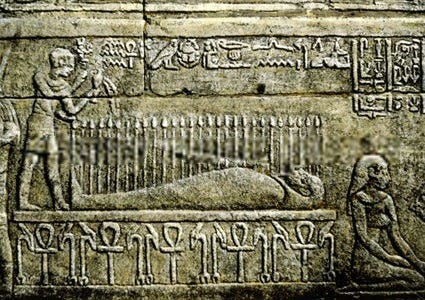
First up is Egyptian god Osiris (~3000 BCE). His jealous brother Set chops him into many pieces, then his sister-wife Isis gathers and reassembles all his body parts (she couldn’t find his phallus, unfortunately) and ties him back together with linen bandages. Missing parts notwithstanding, Osiris and Isis manage to conceive a child, Horus. Osiris immediately descends to rule in the Underworld. He’s still connected with agricultural cycles but from below, pushing up daisies you might say, a chthonic god responsible for the sprouting of plants and the flooding of the Nile.
Tammuz/Dumuzid (~2600 BCE), a Mesopotamian shepherd, is also frequently compared to Jesus. His wife, the goddess Inanna, is obsessed with acquiring new realms and descends into the Underworld to add its territory to her collection, but her sister Ereshkigal kills her and hangs her flesh on a hook on the wall. Eventually rescued thanks to peculiar tiny beings conjured from the dirt beneath the god Enki’s fingernails, Inanna is nevertheless bound by the laws of the Underworld to offer up somebody in her place. She chooses her husband, Tammuz (ouch). And so he is dragged into the realm of death. Eventually Inanna feels some remorse and decrees that Tammuz and his sister can swap halves of the year above and below. Thus we have the myth of Tammuz’ return in the spring associated with the sprouting of crops. Other than Tammuz’ partial resurrection and tie to springtime, this tale of marital strife and auspiciously dirty fingernails does not bear much narrative relation to the story of Jesus.
Attis (~400 BCE), a handsome Phrygian shepherd, is driven mad with love for the goddess Cybele. Engaged to marry someone else, he castrates himself and dies from the wounds. Violets grow from his blood. He is not resurrected, but Cybele pleads with Zeus that his beautiful body be forever preserved and never decay. His cult spread through Asia Minor and the Roman Empire; the Roman festival of Hilaria was in honor of Attis and Cybele (but mostly Cybele) and took place around the spring equinox, a boisterous celebration of the arrival of spring and the sprouting of grain.
Broadly we can say this: in the Mediterranean and Middle East, there were tales of gods who underwent a change of fates and were associated with agricultural cycles. Some of their celebrations took place in early spring, as crops returned to life. There is, however, great diversity among these gods and we cannot neatly put them all in the same category.
I argue that 1. dying & rising gods are not a universal global myth (while there are seasonal agricultural festivals around the world, they are not usually associated with the resurrection of a god) 2. but these particular gods are also not completely separate historical phenomena: they partake of similar themes and agricultural cycles of their shared regional climate. 3. there was not direct, conscious borrowing of the dying & rising gods into the Easter story, nor did they prefigure Jesus’ arrival, as has been claimed. instead, I believe there’s a sort of mythic drift at play here, in which elements of religions and rituals are unconsciously woven into new practices and faiths. I like to think of this in terms of musical scales, a Middle Eastern maqām vs. Indian raga vs. Western tonal system, etc. If you grow up in a culture that uses a particular scale for music, you are more likely to compose, improvise, and listen to music with expectations based upon that system.
No religion descends sui generis from the heavens. I also don’t believe that all religions are secretly alike and that our world’s colorful, delightful, wildly different myths are simply circling the drain of some singular Story. Both of these explanations are resoundingly simple and satisfying, but also a bit lazy. I prefer the intricacies of history, the way we have shared and mixed our myths through flows of people, conquest, intermarriage, and cohabitation, the way they have metamorphosed over millennia yet still sometimes rhyme. What I have in mind is neither direct borrowing nor coincidence nor universal truth, just people living in the same climate, feeling the same seasonal rhythms, composing in the same key without realizing it. As religions and myths move through time and territory, they sea-change—bodies in a season reach for the symbols their historical moment hands them—a Marduk here, a rabbit there, eggs or barley or violets.
In sum: Easter’s springtime symbolism comes from multiple directions, and is not so straightforward (in this case) as the Church plopping an ecclesiastical holiday atop a pre-existing pagan festival. Easter partakes of older mythic themes of the Mediterranean and Middle East, amid a general landscape of agricultural deities and seasonal rites of spring. These spring festivals, usually celebrated as the New Year, were almost always explicitly tied to the vernal equinox (Zagmuk, Akitum, Nowruz, Passover, Hilaria). As is the case with all religions, flavors change as territories expand. When Christianity spread into the Northern European climate, symbols of eggs and rabbits layered over the Mediterranean and Middle Eastern markers of springtime, barley and lambs. Easter eventually made its way to the United States, where we did what we do best: inject it with corn syrup, wrap it in plastic, and sell it back to the rest of the world.
AFTERWORD:
Spring break
What did Jesus do for the three days between his crucifixion and resurrection?
It is an awkward part of the Easter story.
These days, we see death as a one-way ticket, a state change from solid to gas, but in the ancient world it was mostly a location change. Yes, it was spooky and shadowy in the Underworld and you could get trapped there, but Gilgamesh, Orpheus, Heracles, Odysseus, Aeneas, Sisyphus, and Theseus all had jaunts in the land down under and returned unscathed. Going to the Underworld was not necessarily a final destination.
For people in the ancient Levant, it wouldn’t have made sense that Jesus simply blipped out for three days and returned aglow: he must have gone somewhere. Death was not a state of nothingness; it was a place called the Underworld. So, naturally, Jesus must have gone there. And, because he is Jesus, he must have been doing something good during his visit. The Gospels have nothing to say on the matter, but theologians of the early church elaborated upon the Harrowing of Hell,4 as it was named, and it was decided that he was preaching to souls in the Underworld.
As with most matters of the early Church, this was a source of debate, schisms, and excommunications. It did end up in the Apostle’s Creed (“He descended into Hell...”) so is technically accepted by Catholics, although rarely talked about because, now, to our modern sensibilities about death, the concept of Jesus roaming around the Underworld is a bit bizarre. Protestants dismiss the entire idea.
In the Eastern Orthodox Church, the Harrowing of Hell is still celebrated annually on Holy Saturday. The congregation walks in a procession around the exterior of the church before reentering through the doors. Incense is burned, the altar is sprinkled with rosewater, and laurel leaves are strewn. Church hangings are changed from somber Lenten colors of purple/black to white. Joyful hymns are sung. All of this celebrates Christ’s imminent resurrection—shuffling off death and winter, welcoming in exuberant springtime and new life. Perhaps we can even hear a distant echo of the ancient Mesopotamian Akitum festival, where a god departs, his temple is cleansed with lamb’s blood, fire, and water, and then he returns in a procession for his triumphant party.
We must parse out the word “pagan” – the cults and polytheisms of the Greco-Roman world were known as “Hellenic.” Pagan was a derogatory term (essentially, yokel or hick) used in the 4th century to denote the country folk’s stubborn unwillingness to convert. When Christianity spread into Northern Europe, the faiths encountered there were labeled, simply, “barbarian.” We have retroactively extended the word “pagan” to encompass all the polytheisms Christianity ever encountered.
The Council of Nicea (325 CE) mandated a 40 day period (40 days per Moses’, Elijah’s, & Jesus’ wilderness fasts) of dietary restrictions preceding the paschal feast. In the 6th century, the fast was standardized: no meat, milk, cheese, butter, and eggs. It did not gain the name Lent until the 13th century, a shortened form of the Old English word lencten, meaning “spring season,” in reference to the days lengthening.
Or in reverse in the Southern Hemisphere!
Alas we do not have space here to go into the differences between Hell, Hades, Sheol, and Gehenna.
 | A guest post by
|
Good clean fun and methodologically responsible comparative religion. Also, for the record, I think about the Harrowing of Hell every day.
I found this piece fun, although I remain a Christian perennialist who believes that all converges upon the Gospel:
https://beulahrising.substack.com/p/christian-perennialism
Also, the Harrowing of Hell is a totally normal concept to me, central to my understanding of reality.