
Highway 61 Contains Multitudes
The Democratic Visions of Whitman and Dylan


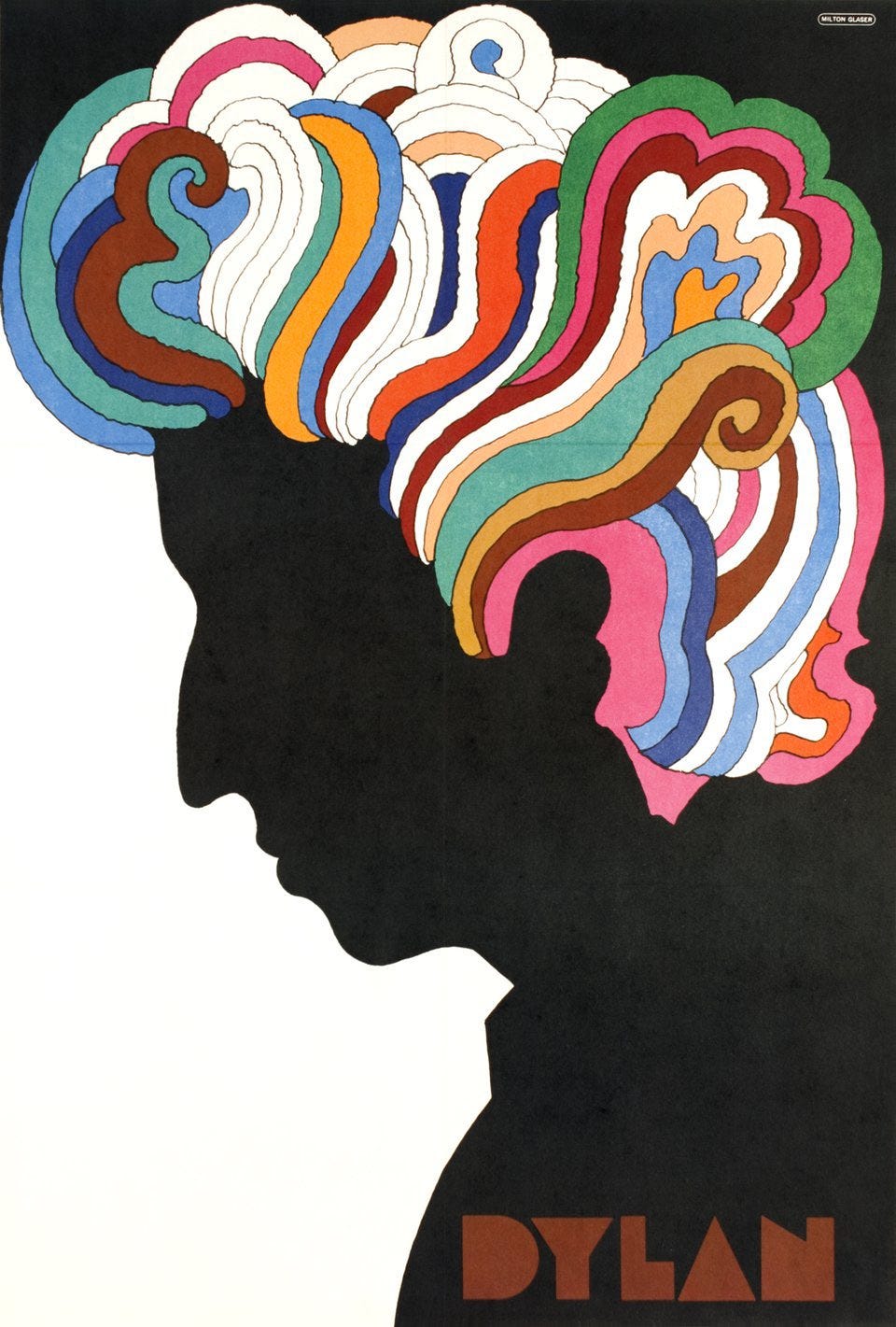
Bob Dylan invokes Walt Whitman in “I Contain Multitudes,” the opening track on Rough and Ready Ways, which the singer released in 2020, after winning the Nobel Prize in Literature. Dylan channels Whitman, as predecessor and tutelary spirit, making the case for an American poetic tradition that links Whitman’s nineteenth-century vernacular transcendentalism with the singer’s own 1960s-era beat surrealism. This linkage should come as no surprise when we consider how many times Dylan implicitly and explicitly responds to Whitman’s call throughout work and career. This is not least because both Dylan and Whitman are poets of democracy, albeit in very different ways.
Leaves of Grass charts Whitman’s mystic process of becoming “in his own person the whole world, the whole universe, the whole eternity of time.”1 He celebrates everyone equally in his democratic vision, putting slave and chief executive on equal footing, for example. Here was Whitman’s response to both Ralph Waldo Emerson and the Civil War; if the new union was going to remain intact, it would have to be because of something more than the tenuous hierarchies Whitman found in every culture. Leaves is his quest to find that something more by displaying himself to others as he really is and by reaching into the inner recesses of his consciousness to discover the true substance of things, to bring back the ideals which could creatively re-constitute America into a democratic polity.
Dylan seeks democracy through different means than Whitman, even as he is far less hopeful about America’s future. He is not nostalgic, however; for him, nostalgia is a kind of stagnation. Dylan has lost his home, if he ever had it, and knows there is no going back; yet he still sets out on his own odyssey, the path of which lies, according to the album Highway 61 Revisited, along the mythologized interstate of the same name. On the road, one finds places like Desolation Row, itself animated by an egalitarian principle, albeit one far less positive than Whitman’s.
Democracy is the common ground on which all men and women can stand: “the provision…of an external and (by convention) timeless locus communis where the ‘I’ and ‘you’ could meet.”2 It is a radical egalitarianism which negotiates dichotomies: “soul/body, collective/individual, nation/state.”3 Democracy is so radical that Whitman feels confident in declaring, “I go with the slaves of the earth equally with the masters.”4 Dylan, on the other hand, offers no legible poetics of democracy. His political ideals are unknowable, partly because over the course of his life he has abandoned both the folk protest movement of Newport and the broader 1960s counterculture of which he was a progenitor. Yet even in his electric albums of 1965/6, one finds lyrics which are “uncompromisingly rebellious, anti-authoritarian, and critical of what he saw as corrupt in American society.”5 Perhaps one ought to class Dylan, on this basis, as a more pessimistic scion of American romanticism, albeit with an individualistic suggesting Emerson as parent more than Whitman.
Granted, Dylan saw himself less as a political figure and more as a poète maudit in the mold of Rimbaud. Dylan in this most significant way overlaps with Allen Ginsberg, a self-consciously American neo-romantic who often invoked Blake and Whitman while chanting in an updated version of their bardic style. Dylan wrote in his Biograph that the Beatnik scene, with its free love, wine, and poetry readings, “woke me up…Jack Kerouac, Ginsberg, Corso and Ferlinghetti…oh man, it was wild—‘I saw the best minds of my generation destroyed by madness’: that said more to me than any of the stuff I’d been raised on….”6 In the poet Anne Waldman’s words, Ginsberg was “Dylan’s most dedicated groupie,”7 Yet Ginsberg saw in Dylan the same forces that had moved his friend Jack and his muse Walt, finding in the words of the emerging poet “an answering call or response to the kind of American prophecy that Kerouac had continued from Walt Whitman.”8
Bob Dylan is an Old Testament prophet, speaking with a voice of rolling thunder. Like Jeremiah, his corpus is an apocalyptic burden, a message he must share with the nation he travails in, yet is still a stranger to. Whereas Whitman sings the potently incarnate Body Electric, Dylan can only sing of the “ghost of electricity” that howls in the bones of his lover’s face, though perhaps also in the faces of all Americans. If Whitman shows a positive re-imagining of what democracy could become in the antebellum, Dylan is the sunglass-sporting cynic of a hundred-odd years later who has watched the dreams of Whitman, Emerson, and Lincoln burn. He bemoans the individual being daily stripped of his existence: John Brown’s face is “all shot up and his hand was all blown off” at the behest of the Masters of War, black prize-fighter Rubin Carter is blamed “for somethin’ that he never done,” the miner of “North Country Blues” is out of a livelihood, and indeed, “everybody must get stoned.”
Yet, counterintuitive though this must seem, Dylan is not a political poet, and despite being one of the preeminent creators of the Counter Culture and inspiring many political activists, he has stayed out of politics altogether,9 thus distinguishing himself from a bevy of American artists who have fallen prey to overt polemicism and partisanship. Granted, in “I Shall Be Free No. 10,” he sings: “Now, I’m a liberal, but to a degree, I want everybody to be free.” Yet while he acknowledges the liberal tropes of his own thinking (the bread and butter of the early folk albums), he looks beyond party politics for a true liberation of society. No longer is it a question of freeing the everyman from the oppression of the bourgeoisie: it is rather a matter of levelling the field: everyone outwardly resembles a blade of grass; no longer is the other completely other:
‘Now, I’m just average, common too
I’m just like him, the same as you
I’m everybody’s brother and son
I ain’t different than anyone
Ain’t no use to talk to me
It’s just the same as talking to you’
The egalitarian ideal has, to be sure, never been realized in the polis: as such, it must take a force outside the polis to bring about lasting change. In its form, Highway 61 Revisited is one of the first instances of an extra-societal chaos come to throw bureaucratic America into disarray, from the burgeoning sound effects at the end of each hook of “Like a Rolling Stone,” to the brooding mystery of “Ballad of a Thin Man.” The change from the calm folk ballad to free-wheeling rock-&-roll is the change from a rather conventional poetics of post-war liberalism to the sweeping neo-romanticism of the ‘60s counterculture.
Characteristically, Dylan has a word for the kind of lyricists he left behind, when he criticized Phil Ochs: “The stuff you’re writing is bullshit, because politics is bullshit. It’s all unreal. The only thing that’s real is inside you. Your feelings.”10 This is not to say Dylan does not have a moral vision, only that his opinions do not make him a political actor. Even in the years leading up to his electric turn, he had already realized that any criticism would not stop the inevitable tide of the government’s encroachment on the individual’s rights. “I stopped thinking in terms of society. I’m not really part of any society, like their society. You see, nobody in power has to worry about…any cat that’s very evidently on the outside, criticizing their society. Because he is on the outside,...he’s not gonna make a dent.”11 By absenting himself, Dylan has abandoned Whitman’s vision of an eminently realizable community of individuals built on egalitarian principles. If that community is a potential reality, he will not live to see it.
And yet, Dylan does sing the song of the grass, just in a different key: he holds up a tarnished mirror to the elites, inviting them to gaze upon their own vices. Like Whitman, he has arrived at these insights the long way round, by sinking into his own mind to find the “geometry of innocent flesh on the bone,” but he goes further than Whitman into the darker, negative climates of his own consciousness, going even as far as hell to bring back visions “more transcendent, less concretely objective, increasingly filled with the shapes of vivid fantasy, with the motifs of the collective consciousness.”12 Dylan’s art is that of the katabasis, of the season in hell–though this will become clearer if we first take a detour to visit Limbo with the They.
The “superhuman crew” Dylan rages against throughout his career are manifold in their incarnations, but can be characterized under three archetypes: executive authority, the government, and the academy. It is essential to note that Dylan remains at such a generalized level in his types: he never deviates from being the critic of society from the outside, he never points fingers at specific people. Granted, in “Hurricane,” Bello, Patty Valentine, and Arthur Dexter Bradley may have had a hand in implicating an innocent man, but it’s “the authorities” who are to blame. Even when, as in “Tombstone Blues,” an individual is apparently indicated, it is in a mode less of individual caricature, than as an archetypal embodiment of the braggadocious absurdity of the rulers of the land:
‘The Commander-in-Chief answers him while chasing a fly
Saying, “Death to all those who would whimper and cry”
And dropping a barbell he points to the sky
Saying, “The sun’s not yellow it’s chicken”’13
Here the president’s power is exposed as that of “a bonehead, who has been pumping iron and is now willing to pick a fight with anything, including the sun.”14 Two less aggressive but no less demeaning portraits of this archetype can be found in the opening stanza of “Desolation Row”:
‘Here comes the blind commissioner
They’ve got him in a trance
One hand is tied to the tight-rope walker
The other is in his pants’
And the senator in Tarantula, “dressed up like an austrian sheep,” who is “on a prune diet and secretly wishes he was bing crosby.”15 The government is slightly more nebulous and nefarious:
‘Now at midnight all the agents
And the superhuman crew
Come out and round up everyone
That knows more than they do’
In true counter-cultural fashion, Dylan portrays the government as repressive and paranoid. The latter adjective is important, and separates Dylan’s conception of the government from that of many of his contemporaries. Yet even the government is apprehensive of something the academy, the “writers and critics” who prophesy with their pens, are also afraid of. Mr Jones, the journalist, who has “been with the professors” and is “very well-read,” is a character who “keeps stumbling into Dylan’s world—though it’s a world he doesn’t understand. He’s a member of the bourgeoisie and this is Dylan’s hipster universe.”16 Something is happening, but he does not know what it is: he, along with the rest of the academics and writers, is baffled by Dylan himself, and by the ineffable realities he paints. Rather than accepting what is outside their comprehension, Mr Jones and his ilk try to nail it to a wall for examination, and Dylan feels that he himself has become one of these fixed objects: “It’s like I’m stuck inside a painting / That’s hanging in the Louvre / My throat starts to tickle and my nose itches / But I know that I can’t move.” Tubba the valve cleaner asks, “how come youre [sic] so afraid of things that dont [sic] make sense to you?...is there anything that does make sense to you?”17
Dylan is sweeping in his criticism of the elite, and in this criticism can be discerned a certain egalitarianism, though, unlike Whitman’s, it is the egalitarianism not of universal aggrandizement, but of cutting down to size. After all, as Dylan writes: “even the president of the United States / Sometimes must have to stand naked.” Yet, in this lyric, Dylan also freewheels on a “dialectic of nakedness” that Whitman had immortalized in “Twenty-eight young men bathe by the shore,” who exemplify how truth and joy can only be found in a collective casting-off of inhibitions, a radical honesty. “Little streams passed all over their bodies. / An unseen hand also passed over their bodies, / It descended tremblingly from their temples and ribs.” There is something both erotic and mystical in this communal unburdening of inhibitions, and it is their nakedness that opens the boys up to the love of the woman.
Whitman views nakedness as an inherently spiritual state. Mark Edmundson, by way of elucidation, cites Wallace Stevens’s “‘You must become an ignorant man again,’” and one is reminded, too, of Christ’s words in the Gospel of John, that “unless one is born again he cannot see the kingdom of God.” By establishing simplicity as a prerequisite to understanding one’s place in the “democratic vista,” Whitman re-affirms the egalitarian principle, the “uniform hieroglyphic” he will continue to chant. “Clothes,” Edmundson notes, “tell the world who we are and where we fit into the social scheme.”18 Yet Whitman desires that there be no hierarchies, that America itself should proclaim its individuality by being composed of equals, “Kanuck, Tuckahoe, Congressman, Cuff,” whose bodies are given and receive the same level of respect.
The turn takes place with the shift from Whitman’s multitude to Dylan’s solitary. If an individual is naked, there is no nobility in this, no honesty—you see somebody naked, and, rather than wishing to join him in his honesty, “you say, ‘Who is that man?’” Nakedness shifts from being a symbolic precondition of corporate honesty and acceptance of our own humanity to exposure, disgrace, and shame: shame, because the individual did not seek to be honest: they were forced to be so by circumstances beyond their control. By capturing the rulers of the land in comical postures, Dylan gives no reason for one to “[kneel] to another nor to his kind that lived thousands of years ago, / Not one is respectable or industrious over the whole earth.”
But Dylan does not follow Whitman in rhapsodizing the beauty of the everyman, either: he does not “behold the picturesque giant and love him”; he can only see the horrendous Hunchback of Notre Dame. Dylan takes the line “Not one is respectable over the whole earth” quite literally. His leaves of grass, his common folk, are almost grotesque in their individuality. Like Dylan himself, they are on the outskirts of civilization—if they are not, they will be, sooner or later, when, like Mr Jones, they are ordinary people bought into the system who now have to face truths they cannot comprehend within their limited frames of reference, or, like, the subject of “Like a Rolling Stone,” they are kicked to the curb after a meteoric career. These types are all perfectly illustrated in the spacious world of “Desolation Row”: each character is a reversal of norms, from the aforementioned blind commissioner to the sailors filling the beauty parlor. “Einstein disguised as Robin Hood” is a ghost of his former, electric-violin-playing self, reduced to sniffing drainpipes, while Ezra Pound and T. S. Eliot, the paragons of high modernist art, are fighting in the captain’s tower of the Titanic. Though the characters move in the mundane sphere of a pantomime, and though the song is played with the Mexico City blues-guitar work of Charlie McCoy, “the song confronts us with recurring hints of imminent disaster.”19
Everything and everyone is languidly locked in the present, teetering on the verge of a cataclysm presaged by the almost-hidden moon, everybody either fatalistically “making love or else expecting rain.” And yet, despite the fact that “the Titanic sails at dawn,” there is no suggestion in the track’s lyrics that this impending doom will ever reach its climax.20 Dylan has moved from the cheery folk-apocalypticism of such songs as “When the Ship Comes In”: the coming (and already-present) chaos sweeps all away, not just those “with God on their side.” Whatever slow train is coming, it signals not the advent of divine judgment, but a time of societal upheaval.
What is one to make of this Kafkaesque nightmare? Certainly, this is the terminus point of American civilization. Al Kooper said that the real location of Desolation Row was Eighth Avenue, Manhattan, a district in New York City known for its proliferation of drugs and prostitution: “Dylan is recognizing a pervasive ‘Amerika’ (as it was called then), one that mutates all humanity and offers insuatory [sic] as well as polarising challenges, challenges against which the old liberal blueprints are worse than useless.”21
In the chaotic interaction of figures from Judeo-Christian, fairytale, operatic, and literary traditions, one sees the perfect image of Mikhail Bakhtin’s idea of the carnivalization of literature, which he traces back to Plato’s Menippean satires, and whose quintessential embodiment is “a pageant without a stage and without division into performers and spectators.” “In carnival,” he explains, “there develops, in a concretely sensuous, half-real, half-play-acted form, a new modus of interrelationship of man with man which is counterposed to the omnipotent hierarchical social relationships of non-carnivalistic life.” We thus have a type of egalitarian society, but one which offers far less hope than Whitman’s, for the citizens of Desolation Row have only achieved a tentative democracy (and one that is still menaced by the superhuman crew) in the face of impending disaster.
What is the poet to do? Even in this den-of-thieves society, this reaction against traditional society, he cannot find lasting solace. “All these people that you mention, yes, I know them, they’re quite lame.” Yet there is no going back to New York City, if one has had enough. Dylan is not bound to any one time or place, for he does not find his home in any one time or place. And yet he will still try to recover that home. In his own words at the beginning of Scorsese’s No Direction Home (2005): “I had ambitions to set out and find like an odyssey, going home somewhere. I set out to find this home that I’d left a while back and I couldn’t exactly remember where it was, but I was on my way there…” Anyone can identify with the Homeric return to a place of safety and comfort which has been lost with the passing of time or change of location: perhaps it is for this reason that so many have resonated so strongly with Dylan’s lyrics. The poet, like Heraclitus, goes out in search of himself. The journey lies along Highway 61, the interstate that stretches from the Gulf of Mexico to the Canadian border.22
Highway 61 is, of course, Revisited on the titular album, and indeed must continue to be revisited (in this unlike Heracleitus’s famous river), as it offers some sort of mystic self-actualization for not only the characters on the title track, but also the entire carnival of figures included in the album.
The problematic biblical scene in which God commands Abraham to kill Isaac takes place in the badlands of Highway 61, where conventional ethics are suspended. Louie the King sends Mac the Finger there to dispose of “forty red white and blue shoestrings / And a thousand telephones that don’t ring,” a symbol of a sort of national incompetency. Incest is being perpetrated here between the second mother and the seventh son, and a scheme between a rovin’ gambler and a promoter to start the next world war is executed on…Highway 61.
Greil Marcus offers the key for the literary and philosophical significance of the highway: “Highway 61 embodies an America as mythical and real as the America made up in Paris out of old blues and jazz records by the South American expatriates in Julio Cortázar’s 1963 novel Hopscotch—a novel which, like a highway, you can enter whenever you choose, and go backward or forward anytime you like.”23 And Cortázar borrows his model of ergodic literature from his compatriot, Jorge Luis Borges, yet another successor of Whitman’s poetics.24 “The Garden of Forking Paths”, “The Library at Babel”, and “Tlön, Uqbar, Orbis Tertius”, portray books, libraries, and whole worlds as labyrinths themselves. Highway 61 Revisited (and the two other electric albums in tow) shows Dylan applying the same process: he takes Highway 61, a mythologized labyrinth of possibilities and traditions, and populates it with his own semiotics and stopoffs to create his own ergodic body.25 The sole reason he is able to effect this radical mythologization is because he saw the fabric of American identity as no longer self-contained, no longer united, as Whitman had hoped it would become. “The canon has crumbled, the ‘authority’ of the author has gone, and the most interesting source for the work is the work itself.”26
With such non-linear texts as “Desolation Row” and “Tangled Up in Blue,”27 a key element of ergodic literature comes to the fore: engagement on the part of the reader: “Considerable effort on the part of the reader is provoked whether the lyric is taken either as one story or as a series of stories.”28 Multiple meanings, multiple narratives, all equally legitimate, all hypostasized into one body at one moment. With the collapse of multiple aspects and meanings into one enacted moment, whether the fixed lyric on the page, or the dynamic nature of the performance, we arrive at Borges’ cultivation of an eternal present, “the simultaneity and convergence of all past, present, and future experiences, regardless of passing time.”29 We see this same motion in Whitman’s poetry, a bid for unanimity by collapsing “the divergence of interpretive interference,”30 which, distilled into one body, reveals itself as a paradox.
Whitman does not reject or dissolve these influences. He holds them all within Leaves at once—God, the sun, religion, government, the least, the greatest, all held within a hypostatic union, each retaining their unique qualities. Whitman creates “a world composed of a ‘limitless’ series of brilliant finite events each of which imposed closure at the grammatical end of its account.”31 Life and death, beginning and end, are not poles on a spectrum, but ceaseless continuations of the “cradle endlessly rocking.”32 All motion is part of the “simple, compact, well-join’d scheme” of the kosmos, and of Whitman’s ergodic body. Whitman himself describes Leaves as a multi-linear library of motion and ideas: pluralization within the unified space of the book: “The play of Imagination with the sensuous objects of nature for symbols and Faith—with Love and Pride as the unseen impetus and moving-power of all, make up the curious chess-game of a poem.”33 Chess: the answer to Stephen Albert’s riddle in Borges’s “The Garden”: a set grid with a finite number of elements and limitless possibilities.
Dylan and Whitman are caught between the past and present in a shifting nation of clashing forces. Democracy, as they imagine it, was not and will not manifest itself in their lifetimes, if ever. And yet, their lyrics serve to creatively imagine the individual’s move towards democracy. By holding together multiple viewpoints and end points in their lyrics, they invite the reader to explore their corpora to discover one’s own place in the democratic body. They do not dwell with nostalgia on the past: therein lies death. They do not romanticize the future: therein lies disillusionment. They do not become embroiled in the present’s conflicts, but loafe apart and invite the reader to set out with them along the uncertain path of Highway 61 to find that home once lost. Its possibilities are large: it contains multitudes.
—Jones Hogsed
Edwin Haviland Miller, A Century of Whitman Criticism (Bloomington: Indiana University Press, 1969), 155.
Allen Grossman, “Poetics of Union in Whitman and Lincoln”, in The American Renaissance Reconsidered, ed. Walter Benn Michaels and Donald E. Pease (Baltimore: Johns Hopkins University Press, 1985), 188.
Grossman, 194.
Grossman, 193.
Jerzy Jarniewicz, “Bob Dylan: The Unwilling Icon of the Counterculture”, in All Along Bob Dylan: America and the World, ed. Katrin Nash and Paweł Markowski (Kraków: Jagiellonian University Press, 2020), 91.
Gray, Song and Dance Man III, 84, n. 56.
Sean Wilentz, Bob Dylan in America (New York: Doubleday, 2010), 76.
Wilentz, Bob Dylan in America, 53.
With a few tragically comedic instances, e.g. Førland, Tor Egil. “Bringing It All Back Home or Another Side of Bob Dylan: Midwestern Isolationist.” Journal of American Studies 26, no. 3 (1992): 338, n. 1. http://www.jstor.org/stable/27555682.
Bob Dylan, quoted in Anthony Scaduto, Bob Dylan: An Intimate Biography (New York: Grosset & Dunlap, 1973), 205.
Dylan, quoted in Scaduto, Bob Dylan, 205.
Ibid., 206.
This stanza also contains a noteworthy example of what could be read as political sycophancy, as John the Baptist, a saint and mystic who should have thrown off the shackles of political favor-mongering, seems to be the president’s bully-boy, who ‘after torturing a thief, / Looks up at his hero’, i.e. the president.
Ben Burrell, “S3 Ep8: ‘Highway 61 Revisited Part 4,’” Bob Dylan: Album by Album, August 26, 2019, podcast audio, Spotify,
Bob Dylan, Tarantula (New York: Macmillan, 1971), 4.
Ben Burrell, “S3 Ep7: ‘Highway 61 Revisited Part 3,’” Bob Dylan: Album by Album, August 19, 2019, podcast audio, Spotify,
Dylan, Tarantula, 40.
Song of Ourselves, 20.
Gray, Song and Dance Man III, 135.
Gray, 136.
Gray, 136.
Greil Marcus, Like a Rolling Stone: Bob Dylan at the Crossroads (New York: PublicAffairs, 2005), 165.
Marcus, Like a Rolling Stone, 167.
Espen Aarseth first coined this term, derived from the Greek words ergon and hodos, “work” and “path”, respectively. “In ergodic literature, nontrivial effort is required to allow the reader to traverse the text. If ergodic literature is to make sense as a concept, there also must be nonergodic literature, where the effort to traverse the text is trivial…when you read from [ergodic literature], you are constantly reminded of inaccessible strategies and paths not taken, voices not heard. Each decision will make some parts of the text more, and others less, accessible…This is very different from the ambiguities of a linear text. And inaccessibility, it must be noted, does not imply ambiguity, but rather, an absence of possibility–an aporia.” Espen Aarseth, Cybertext: Perspectives on Ergodic Literature (Baltimore: Johns Hopkins University Press, 1997), 1-3.
Gray, Song and Dance Man III, 660.
Gray, 158.
Gray, 261.
Aidan Day, quoted in Gray, Song and Dance Man III, 261. Reader, or, in this case, the listener; the aspect of performance adds to the multidimensionality of the texts. In Dylan’s case, no two renditions of a song are alike: the listener has to grapple with the current performance’s interior, but also with the performance in relation to other performances of the same song. Cf. Jarniewicz, “Bob Dylan”, 284.
Gene H. Bell-Villada, Borges and His Fiction: A Guide to His Mind and Art (Chapel Hill: University of North Carolina Press, 1981), 96.
Grossman, 205.
Grossman, 189.
Miller, Critical Guide to Leaves of Grass, 110.
Miller, 3-4. Emphasis mine.
 | A guest post by
|
Stunning piece -- the Bakhtin/carnival framing for Desolation Row is honestly the best lens I've seen applied to that song. The most interesting thing about the Dylan-Whitman pairing is that both try to hold contradiction rather than resolve it: Whitman through affirmation, Dylan through satire. I spent a semster studing Whitman in relation to American political theology, and the gap was always this: Whitman believes the container can hold everything, Dylan suspects the container is already cracked. The Borges connection cements that perfectly.