
The Infernal Technique
Speculations on Romanticism, Technology and Subjugation


I wrote1 last year of my misgivings about the “New” Romanticism by recounting what appeared to me the unresolved (and perhaps unresolvable) problems of the original romantic project. What does the new medicine propose as cure for the old mal du siècle? I’m unsure anyone has provided an adequate answer, but another of my resolutions is never to suffer unnecessarily the despondency of inaction. My caution is not only unwarranted, but ill-advised; since for various reasons, not least of which the increasing thinness of time, I’ve come to realise how high the stakes are.
Paul Franz posits that “the question concerning technology—seems an essential aspect of the Romantic question, today,” and I agree completely, as I do also with the following:
Romanticism rejects the triumph of the empirical; it continues to see the world in the light of desire. Vitalism—raging against the dying of the light—is a version of that same spirit. Both assert life against death.
[…]
Vitalism implies concentration. Vitality, a concept of difference, concentrates itself in this location, rather than another. Even if it is not always my vitality, even if I do, in the classic way of the Romantic poet, become channels for forces beyond me (“not I, not I, but the wind that blows through me”), it seeks not equilibrium with its environment, but a kind of strife, though perhaps a strife that raises the environment to a higher power.
We ought to admit the principal opposition confronting us is that between romanticism and technology. How is there to be a new age of romanticism in the present age of technological anomie? Perhaps the former has yet to be elaborated fully because our understanding of the latter is not yet adequate. Romanticism seems to stand in direct opposition to technology as such, but I think we ought to be more specific—for technology is nothing without “technique.” We cannot yet say exactly what a New Romanticism might constitute, but Franz comes close—and in the process reflects a perennial wisdom, that the new romanticism—if it is indeed a vitalism—should in all circumstances seek to assert life over death. Technology, in and of itself does not make such distinctions—but the regime of infernal “technique” is unequivocally a regime of death.
In the same essay, Franz considers a fascinating debate between Marshall McLuhan and Norman Mailer, who play the roles of technological evangelist and irascible romantic, respectively. In this exchange there appears to be an instructive opposition between two aesthetic sensibilities; the former apparently in thrall to the technology of the present; the latter mired in nostalgia for the past. Most interesting is McLuhan’s point that “Nature” has become a utopian and nostalgic “representation.” It is interesting, in my view, insomuch as it actually describes a profoundly romantic tendency, an aesthetic commitment to the “present,” which is only
faced in any generation by the artist. The artist is prepared to study the present as his material because it is the area of challenge to the whole sensory life, and therefore it’s anti-utopian. It’s a world of anti-values. And the artist who comes in contact with the present produces an avant-garde image that is terrifying to contemporaries.
What McLuhan describes is the perfect encapsulation of the modernist impasse, itself (as Franz well knows) a forestalled and deferred iteration of the romantic impasse. The uninitiated will see in McLuhan’s description of anti-utopia, anti-values and “avant-garde” the supposed antithesis of the original Romanticism. But the original was in theory—if not always in practice—a commitment to the present’s own strife, and not merely a philistine exaltation of an illusory past, nor a fixation only with the picturesque nostalgic image. Nietzsche deemed the realm of art the only properly metaphysical activity in his own age of Nihilism.
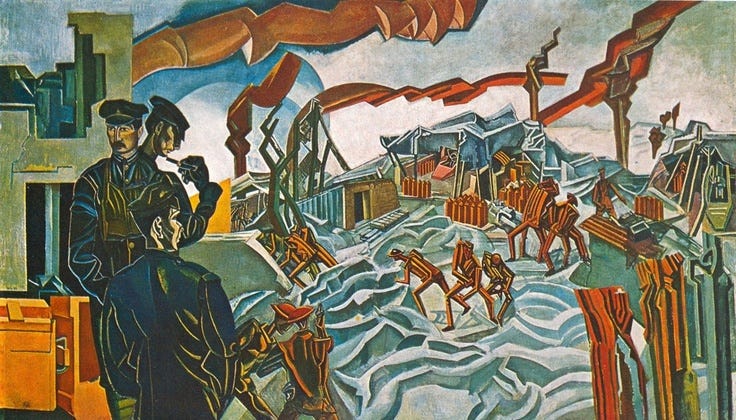
I believe this still to be the case in our own age. The fate of the modernist romantic was to seek whatever salvation and redemption that could be got at in his disconsolate age of rampant technique—and, in retrospect, it matters little that the nature of this attempt was putatively “secular” as opposed to Christian, or indeed that it ultimately failed, that salvation remained tantalisingly out of his grasp. It matters only that the attempt was made. Even a man with such fundamentally anti-romantic impulses as Wyndham Lewis could not deny the inherent romanticism to be found in the trenches of The Great War, the first technological war—where the romantic might have been thought to have died a certain death:
So we plunged immediately into the romance of battle. But all henceforth was romance. All this culminated of course in the scenery of the battlefields, like desolate lunar panoramas. That matched the first glimpses of the Pacific, as seen by the earliest circumnavigators. Need I say that there is nothing so romantic as war? […] I am not a romantic— though I perfectly understand romance. And I do not like war. It is under compulsion that I stress the exceedingly romantic character of all the scenes I am about to describe. If your mind is of a romantic cast, there is nothing for it, I am afraid. […] It is commonly remarked that “there is no romance in modern war”. That is absurd […] It is like saying that love can only be romantic when a figure as socially-eminent and beautiful as Helen of Troy is involved […] but men are indifferent to physical beauty or obvious physical splendour, where their emotions are romantically stimulated. Yes, romance is the enemy of beauty. That hag, War, carries it every time over Helen of Troy.
Yet perhaps Romanticism didn’t die? Perhaps it simply jettisoned its rather cumbersome fixation with obvious beauty (which in most cases is simply a fixation with equilibrium), to find it instead within strife, in strenuous effort, in action – in things which are unquestionably alive. Among those that actually did die were two of Lewis’s mates, the philosopher T.E Hulme—by all accounts a large, imposing and pugnacious character, full of life and vitality, decidedly anti-romantic in word if not in deed, reportedly blown to pieces after being hit directly with a shell. The other was the rather absurdly talented young sculptor Henri Gaudier-Brezka, about whom Lewis wrote the following:
It is easy to laugh at the exaggerated estimate ‘the artist’ puts upon his precious life. But when it is really an artist—and there are very few—it is at the death of something terribly alive that you are assisting. And this figure was so preternaturally alive, that I began my lesson then: a lesson of hatred for this soul-less machine, of big-wig money-government, and these masses of half-dead people, for whom personal extinction is such a tiny step, out of half-living into no-living, so what does it matter?
Neither the technological conditions of the Western Front or the death of his friends in “England’s Stupidest War” could negate the romantic character of everything Lewis saw in the trenches, which only modified his earlier and limited fixation with the possibilities offered by technology for Art. What does this tell us? Firstly, that the romantic temperament must be a way of seeing as well as a way of being. Second, that it is an involuntary disposition that can exist despite a stated opposition to the nostalgia of utopianism and its sham values, and yet can still fulfil the essential condition of asserting life over death. Lewis’s opposition was to technique, not technology per se.
In 1983 a reclusive mathematics prodigy and erstwhile academic—he had been made Assistant Professor at the tender age of 25—wrote a letter to the French philosopher Jacques Ellul. The letter was eight pages long and consisted of a pointed critique of Ellul’s book The Technological Society (1954), which the mathematician greatly admired and claimed to have read six times. He had a number of objections, however, to Ellul’s complex dialectical argument. One of these was Ellul’s insistence that he was not against technology per se but quite specifically against “technique.” For Ellul, “technique” concerned systems which once derived from technology, but have developed to become autonomous from it, and are now responsible for determining the fundamental structure of modern societies. For Ellul, in common with the luddites, technology was still something to be “mastered” and fully subjugated to human needs. The mathematician found these notions “dangerous”:
It is senseless to speak of “mastering” an advanced technology without subordinating ourselves to large-scale organization. And large-scale organization cannot exist without means for physically or psychologically compelling people to act in accord with the requirements of the organization. […] I fully agree that the real target is the technological society and not technology; but advanced technology cannot exist without the technological society, and moreover the attempt to use an advanced technology tends to create a technological society. Therefore technology itself must be condemned.
We see here a certain misapprehension that the New Romanticism should to try its best to avoid. The above are the words of a latter day romantic revolutionary figure in all of his imperfections; a man who, out of a desperate and restless longing, has put his entire faith in grand symbolic gestures and absolutes; a man disenchanted with the society he once inhabited, and brutally tortured by it; a man whose rupture from civillisation was absolute, who fled into the embrace of nature—only to find the fallen world he had escaped steadily and relentlessly encroaching upon his solitude. He would end up lashing out in violent, murderous but ultimately impotent ways. His was a “romanticism” that is hard to admit, but one which cannot, in the end, be denied.2 The mathematician was, of course, none other than Theodor Kaczynski—The “Una Bomber.’
There is a certain memefied portrayal on the internet of Kaczynski as a prophet of contemporary technological anomie (“Uncle Ted”). According to his brother, Ellul’s book was the closest thing that Uncle Ted had to a Bible, and the mark of its influence is felt throughout Kaczynski’s somewhat turgid manifesto. It’s difficult to say what drew Kaczynski to Ellul’s text. There is much in The Technological Society that comes off as hyperbole, and it has a certain learned quality—part theological, part prophetic—which makes it incredibly persuasive and almost charming in its relentless pessimism. Though I was aware of the text when I was younger, I only seriously read it relatively recently. I believe my earlier resistance came from a regrettable and decidedly adolescent aversion to Ellul’s anarchic religiosity (seemingly a nonconformist Protestantism situated uneasily between the poles of Jesus and Marx). According to Ellul, “Technique” is something which exists outside of the realms of human moral and ethical control, and it is the gravest threat that exists to human freedom and flourishing:
The term technique, as I use it, does not mean machines, technology, or this or that procedure for attaining an end. In our society, technique is the totality of methods rationally arrived at and having absolute efficiency (for a given stage of development) in every field of human activity. […] This definition is not a theoretical construct.
Ellul’s elaboration of the emergence and development of technique can feel at times convoluted, but there is no question that he has written one of the more prophetic works of cultural criticism of the twentieth century. His claims for the autonomy of technique find most resonance in the present, where human interest and needs are completely subordinated to the potential of disruptive, destructive, and catabolic technological advancements, propelled by nothing more than the fact of their possibility. Particularly incisive is Ellul’s observation that the most efficient and amenable political and economic systems for the flourishing of technique are totalitarian in nature:
The dictatorial state has efficiency as its goal. It submits to the law of techniques, for it understands that only by giving techniques free rein can it hope to derive the maximum profit from them. Whatever techniques are involved – human or physical, economic or educational – the state musters around it all available technical instruments. This occurs spontaneously, by chance; but in dictatorial states it is voluntary, calculated and studied (and therefore the process occurs more rapidly). It is the end sought by all forms of state, The Communist knows that technical progress means the progress of the proletariat. The Nazi knows that he is the instrument of state power; he cannot conceive that anyone would allow its limitation.
The objectless and instrumental ideologies of ‘woke’ technocratic liberalism merely serve the same purpose that previous ones have, and have the added advantage of being palatable and inoffensive, and very far from openly malevolent. But Ideology, alongside “technology,” must always be subordinate to “technique”—the ruthless pursuit of inhuman efficiency and absolute power and domination. Indeed, it is precisely the lack of efficacy or telos that betrays the spectral hand of “technique” at the levers of the ideology of liberal politesse and superficial representation. For Ellul “the very assimilation of ideas into the technical framework that makes them materially effective makes them spiritually worthless.”
If the New Romanticism really does wish to assert life against death, to resist integration and equilibrium with its present environment, to create generative strife – then there is a pressing need to be specific about the nature of its resistance. The Luddites’ spiritual revolt was not (or not just) directed against the machine, but the logic which it had inculcated—not against the instruments of technology, but against the incipient dominance of “technique.” The inability to recognise this distinction risks squandering the creative energies potentially unleashed by a “New Romanticism,” which are themselves capable of surmounting the evil it faces—provided it knows first the nature of that evil. The cause is very far from lost, but Ellul’s prophecy ought to have the last word in describing what losing might yet entail:
With the final integration of the instinctive and the spiritual by means of these human techniques, the edifice of the technological society will be completed. It will not be a universal concentration camp, for it will be guilty of no atrocity. It will not seem insane, for everything will be ordered, and the stains of human passion will be lost amid the chromium gleam. We shall have nothing more to lose, and nothing to win. Our deepest instincts and our most secret passions will be analyzed, published, and exploited. We shall be rewarded with everything our hearts ever desired. And the supreme luxury of the society of technical necessity will be to grant the bonus of useless revolt and of an acquiescent smile.
—Udith Dematagoda, January 2026
At the beginning of a new year I have given myself the task of continual provocation – towards myself in particular, but also towards others.
It was one distinctly familiar to Joseph Conrad, whose first model for it may have been his own father—a romantic poet and hapless patriot. Conrad would go onto create many memorable iterations of this peculiar type in his magisterial novels: the romantic of the “lost cause.”
 | A guest post by
|
Why do we assume romanticism is out to cure something? Isn't this the same criticism Arnold leveled against it? If the goal is to heal, is it the world or the self?
Check out Frank Lentricchia's Crimes of Art and Terror. Beautiful book. Reads Wordsworth and Ted K and Conrad (didn't they find The Secret Agent in the cabin) all together (among others: Melville, Scorsese, Cassettes, Mann, etc). Argues that all post-romantic visionary art is apocalyptic.
Characteristically vital work, Udith. I'm interested in how you position Lewis in relation to your recent remarks about action (here and in 'Poetry in Motion'). Lewis was deeply critical of 'the gospel of action'. Nor did he think all forms of artistic genius are founded on 'the agent-principle'. Of Shakespeare, he claimed that 'the character of his genius was responsive and not active'. Inaction is not, in every case, a matter of despondency. Or perhaps we should say that, in the highest forms of inaction (i.e. the vita contemplativa), the very distinction between activity and passivity dissolves.